
In a first for North of Here, I’m delighted to include a great new article from friend and writer John Dore, who previews the forthcoming tribute to Karl Wallinger that will take place on Sunday 25th October 2026 at Shepherd's Bush Empire, London.
Some thoughts ahead of the Karl Wallinger tribute gig in London on 25th October.
OCT 23
On Sunday evening, twenty musicians from across Karl Wallinger’s career will gather at Shepherd’s Bush Empire to celebrate the life and music of the man behind World Party.
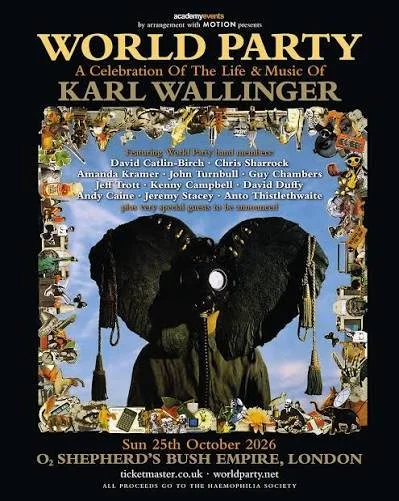
Four of them share an unusual connection to him. Guy Chambers, Chris Sharrock, David Catlin-Birch and Steve McEwan helped create one of the biggest hits of the 1990s. Wallinger wrote that song. He recorded it. He released it. Then it made somebody else a superstar.
By Wallinger’s own account, it also cost him his friends. The song was She's the One.
It is a story of friendship, ambition, ownership, bruised egos and money. And it holds one of the strangest ironies in pop. The recording that hurt Wallinger most would carry him and his family through his darkest years.
From Waterboy to World Party
Karl Wallinger was a musical polymath. He was educated at Charterhouse, a couple of years behind his future collaborator, Peter Gabriel. He joined Mike Scott’s Waterboys in 1983 and helped build the “big music” of This Is the Sea and its towering single The Whole of the Moon. In 1985, he struck out on his own and founded World Party.
The name was misleading. World Party was essentially a one-man operation. Wallinger wrote the songs, played most instruments, and produced the records. He was a perfectionist and a magpie. He took the Beatles, Dylan, Prince, soul and psychedelia and made something unmistakably his. Private Revolution (1986), Goodbye Jumbo (1990) and Bang! (1993) stand with anything a British artist made in that era.
By 1997, he was finishing his fourth album, Egyptology.
One of its songs had an unusual origin. Wallinger had been asked to write a title song for the 1996 film She's the One, starring Jennifer Aniston and Cameron Diaz. He wrote it quickly. Then the soundtrack became a Tom Petty project solely. Wallinger was left holding a beautiful song with nowhere to go.
He put it on Egyptology. It should have been a hit. It wasn’t. Wallinger admitted he had resisted making a video. The album ran into trouble with the record company and management. The song slipped by almost unnoticed. Then Guy Chambers came calling.
From World Party to Robbie’s party
Chambers knew Wallinger well. He had played keyboards in World Party and learned at the elbow of a remarkable musician. Then he went after his own songwriting career. By 1997 he had found it, in a new partnership with former Take That member Robbie Williams.
This summer Chambers told his side of the story in a Substack piece, From World Party to Robbie's Party. He had given Robbie a copy of Egyptology while the singer was in rehab in 1997. Robbie loved She's the One. He wanted to record it, and Chambers started on the cover in 1998, during the sessions for I've Been Expecting You.
This is where the story turns.
Chambers didn’t build a new band. He hired the musicians who had just been on the road with World Party. Chris Sharrock on drums. David Catlin-Birch on bass. Steve McEwan on guitar. Chambers on piano. They knew the song. Some had played it live with Wallinger.
They added strings, a Beatles sheen and Robbie’s voice. Chambers says he even approached Paul McCartney, George Harrison and Ringo Starr. None took part. It didn’t matter. Chambers took Wallinger’s arrangement, scaled it up for a bigger audience, and created a magnificent piece of pop production.
There was one problem. According to Wallinger, nobody told him.
The price of success
Imagine it. You write a song. You record it. You tour it with your band until it has a sound of its own. Then you find out your band has gone off and recorded it with one of the biggest pop stars in Britain.
And it goes to number one.
Robbie's She's the One was released in November 1999 and went straight to the top of the UK singles chart. At the 2000 Brit Awards, it won Best British Single and Best British Video. For Robbie, it became a signature ballad. For Chambers it was another triumph in an astonishing partnership with Williams.
For Wallinger, it was complicated. He told The Arts Desk: “It’s a double thing: on the one hand, you lose your friends; on the other, you make a lot of money.”
The song that saved him
Then everything changed. In February 2001, Wallinger suffered a catastrophic brain aneurysm. He survived. The recovery was long and hard. His sight was damaged. His ability to make music was profoundly affected. For a man who had turned ideas into sound almost without effort, it was devastating.
World Party vanished for years. The royalties from Robbie’s record kept arriving.
The song that had cost him his friends now kept his family afloat. Wallinger was frank about it. In 2012 he told The Arts Desk that Robbie's version “saved my arse financially”. He called it “a crazy bit of luck". The royalties, he said, “kept us all in fried bread for a while”.
The musicians whose departure had hurt him had made the record that carried him when he could no longer work.
Gratitude didn’t settle everything. Years later, Chambers recalls, Robbie introduced “She's the One” at a concert by joking that it was the song he was proudest of writing. Wallinger’s daughter Nancy sent the clip to her furious father. Wallinger then stopped Robbie from filming performances of the song. Chambers believes Robbie enjoyed needling Karl, feeling Wallinger had never properly appreciated what the cover had done for him.
The strange arithmetic of creative friendship
If we pull back, a pattern appears.
Wallinger wanted more room than The Waterboys could give him. He built World Party. That schism never seems to have been resolved: the original Waterboys, Anto Thistlethwaiter and Steve Wickham, are due to perform on Sunday, but Mike Scott is notably absent.
Chambers wanted his own songs. He found Robbie. Chambers and Robbie wrote Angels, Millennium, Rock DJ and a string of hits. Then they fell out too. Years of estrangement passed before they found their way back.
Every time, the move that made one artist’s career may have felt like a betrayal to somebody else.
That is the arithmetic. Great creative partnerships run on intimacy. You hand someone your half-formed ideas and your insecurities. You make something together that neither of you could make alone. But the industry doesn’t count “together”. It counts writers, performers, credits and royalties.
The song belonged to Karl. The sound belonged, in part, to the band. The fame belonged to Robbie. Everyone had a claim. Nobody had the whole thing. There are no villains here. Just talented, ambitious, complicated people in a business that turns closeness into contracts.
The party comes together again
Which brings us back to Shepherd’s Bush Empire on Sunday 25 October 2026.
Musicians from every incarnation of World Party and from the wider family Karl built over four decades will be there, including Chambers, Sharrock, Catlin-Birch and McEwan.
Wallinger died in March 2024, aged 66. He won’t hear them. We can't know how he would have felt, or whether time had softened the old grievances. It would be too easy to manufacture a happy ending. Playing together is not the same as forgiveness.
But it is moving all the same. People who once went separate ways, sometimes painfully, will arrive on the same stage to play the music of the man who connected them. Nobody is chasing a number one. The songs: Ship of Fools, All Come True, I Fell Back Alone, Is It Like Today, still matter more than anything else
Songs outlive the circumstances that made them. They change hands. They gather meanings their writers never imagined. Sometimes they make people rich. Sometimes they break hearts. And sometimes they bring people back together. That might be worth more than a royalty cheque.
I cannot begin to imagine what it will feel like for the audience and band when the piano starts, and someone other than Karl or Robbie sings: “I was her. She was me. We were one. We were free.”
John’s original article plus his other excellent writing and musings can be found on his “Wave Your Arms” pages on Substack here.
In addition he has a fantastic novel, Seven Dials available (I also reviewed the book here).