
BETWEEN THE LINES: Patrick Grant, Less
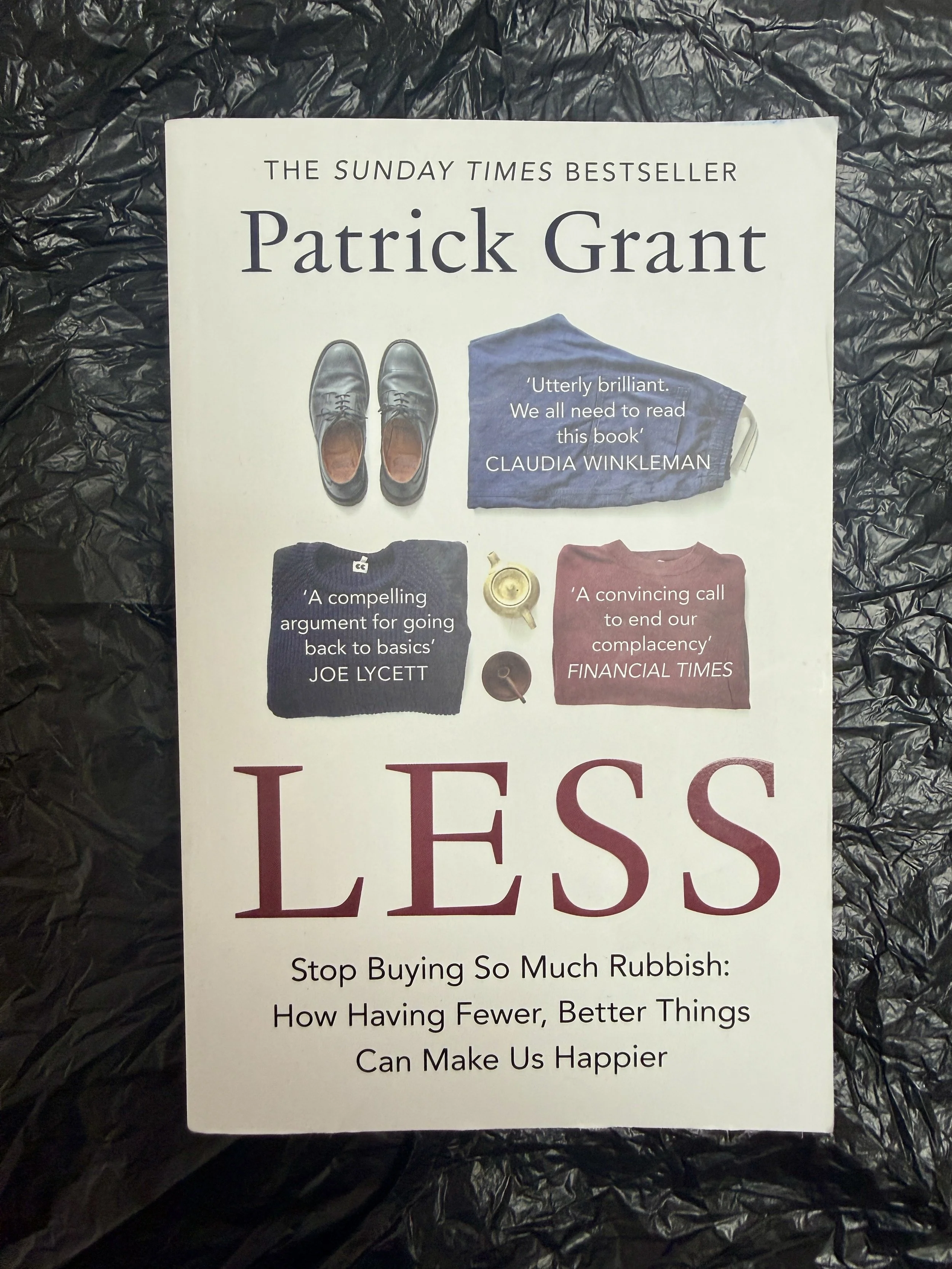
Stop Buying So Much Rubbish - Patrick Grant’s book, “Less” (Image: Damien Wilkinson)
Patrick Grant’s “Less” book, published in 2024, tackles the ultra-wide topic of reducing the vast amount of unnecessary consumption from our lives, harnessing his Savile Row based expertise of the UK’s textile and fashion industry.
“Bee” Sustainable
A familiar face on TV (“The Great British Sewing Bee”, “Coronation Tailors: Fit for a King”) Grant, is a strong advocate of sustainable, regenerative practices underpinned by traditional and made-to-last craftmanship. He has played a key role in practicing what he preaches, especially as founder of “Community Clothing” in 2016, born out of the demise of Blackburn clothing factory Cookson & Clegg.
Community Clothing aims to sells top quality clothing at prices below that of premium brands, whilst sourcing its products from the UK, creating and sustaining local jobs and economies.
Cutting his cloth
Grant approaches what is a considerably far-reaching topic, with a personal and poignant starting point.
He emotively describes what makes him happy, drawing out key items of furniture, clothing and such like and weaving this into a vision of simplicity with a desire for long lasting, well-constructed, high-quality items.
Knitting the History
A further introductory section moves to a macro setting as Grant knits together the move from the “Age of Hunters” to the “Age of Commerce”, outlining the history of man’s relationship with clothing and the slow evolution from practical necessity to a statement of fashion.
The main sections of the book are neatly cut into four ‘patterns’.
Part 1: Want
Grant further embroiders the explosion of demand for clothing items, propelled by the industrial revolution and an ability to mass produce and satisfy such a want.
A move from the 16th century, where the cost of a wool suit was more the twice the annual salary of some workers, to a position where the upper classes became threatened by the lower classes beginning to mirror their clothing style.
The marketing and advertising boom of the late 19th century and 1920s stimulated further demand and more focus on ‘fashion’ for the elite. This consumptionism and requirement cycle of everything being ‘more than last year’ reached an inevitable nadir with the Wall Street Crash of 1929 and the resulting Great Depression in the US.
More recently the growth of Far Eastern online disruptors such as Shein and Temu and the associated decline of more traditional players is starkly analysed with the amount of unused clothing that ends up in landfill.
The scale is staggering: Grant notes that approximately 100 billion items of clothing are produced globally every year. In the UK alone, we discard an estimated 336,000 tonnes of used clothing into the bin annually. It’s a literal mountain of waste that exposes the 'disposable' lie of ultra-fast fashion.
Part 2: Need
Using the history of man’s relationship with clothing dating back thousands of years, Grant charts the underlying need from clothing, namely warmth, protection and identity.
Research cited by Grant suggests the average person wears only 20% of their wardrobe 80% of the time. Despite owning more than ever—with the average person now buying 60% more items of clothing than they did 15 years ago—we only keep them for half as long.
Grant strips back our modern wardrobe to the bare essentials, exploring the psychological shift from clothing as a functional skin to clothing as a disposable commodity. He argues that by understanding the true need—warmth, protection, and identity—we can begin to reject the hollow cycle of fast fashion.
Part 3: Make
Grant’s career has been characterised by being in the thick of things. Right from starting out on Savile Row and developing the tailoring and textile knowledge he has utilised throughout his life in textiles.
His story is weaved around the wider history of textile manufacturing from the early ages through the halcyon days of the 19th and 20th century, and the resurrection of fallen icons (brands such as Norton & Sons, and E.Tautz & Sons, and textile manufacturer Cookson & Clegg), it’s a fascinating journey in resilience and focus on delivering his core values of craftmanship, quality and local pride.
The growing disconnect between the wearer or user not knowing how something is made, has the unfortunate consequence of a resulting loss of respect for the item itself. This is compounded by a modern day education system that rarely results in pupils actually making things and therefore unable to appreciate a product’s quality.
Part 4: Less
We’ve become conditioned to a situation where some items of clothing cost the equivalent of a cup of coffee, devaluing the labour involved in manufacturing.
Grant advocates owning fewer, better things that have the capability of ageing well and offering much longer service than the cheaper and short lived, landfill ready, fast fashion items that dominate the market.
Of particular note, are multitudes of data that highlight a growing drop in the happiness levels of the population, suggesting the constant yearning for yet more items is very counter productive.
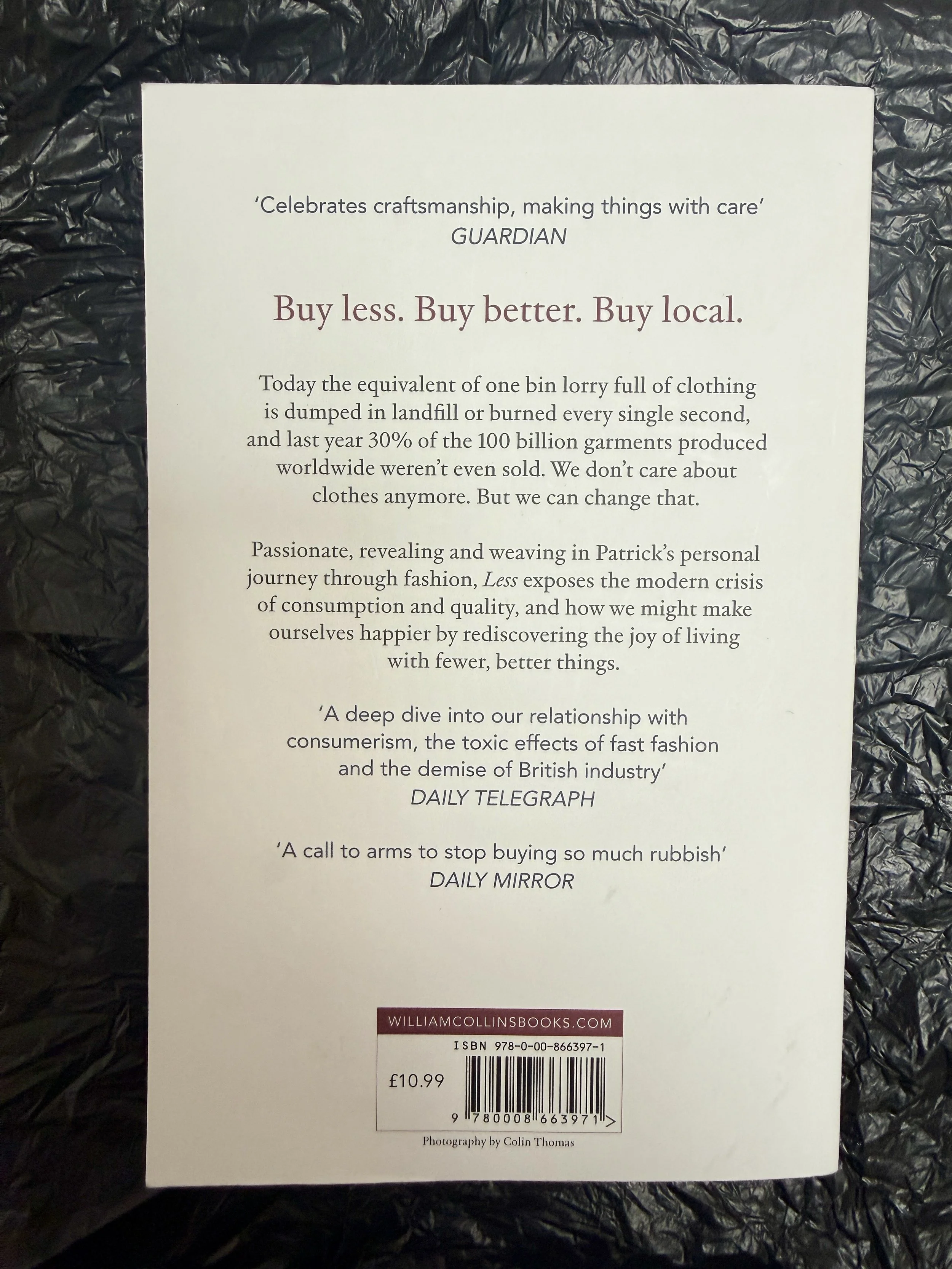
Buy less. Buy better. Buy local - Patrick Grant’s book, “Less” (Image: Damien Wilkinson)
Conclusion: A Stitch In Time?
Grant’s well-crafted book delivers a stark yet compelling vision of what he rightly terms a crisis.
It is a call to arms for anyone feeling, what James Wallman has coined, "stuffocated."
Grant has done the “hard yarns” during his time in the textile and fashion industry and his views hold much weight in any consideration of the important topics of sustainability and the benefits of keeping manufacturing locally focused.
Indeed, the latter is an area Brexit, with all its grandiose ‘Made in Britain’ intentions, has surprisingly not capitalised upon with any real conviction.
So, what does it mean for me, personally?
I am, perhaps, the 'Patient Zero' of Grant’s study. Despite championing local makers, I still find myself reeled in by the dopamine hit of a cheap, transitory purchase. My head knows the value of a HebTroCo trouser, but my wardrobe still tells a story of impulsive 'quick hits.'
To put Grant's philosophy to the test, I’m committing to a 30-day 'Purchase Fast'—a total reset of my spending habits which I’ll be documenting in my next post.
The book encapsulates a number of key themes be it the historical development of clothing, textiles and fashion, the economic and emotional pitfalls of where things currently are precariously stood and Grant’s compelling suggestions for a better way forward, from his extensive experience.
Whilst the direction of the textile ‘tanker’ won’t be changed quickly, there is enough weight of thought promoted within the book to help us champion a different way forward.
By looking backward at our manufacturing heritage, Grant provides a clear map forward to a more sustainable and considered future.
———————————
Pulling the Strands together: Grant’s mission resonates loudly in a number of Brands I’ll be championing in future articles (including HebTroCo, Hestra, Red Wing and Barnes and Moore). Like Grant, these makers prove that the "Golden Rule" of style remains: Buy once, buy well.
