
““With my dad by my side””
A 70s Revolution @33rpm
No 1970s household was complete without the existence of a record player, some loudspeakers and a collection of vinyl records in the corner of the living room.
The crackle of the needle on the vinyl, whilst the sound competed with the loud, swirling patterns of the wallpaper, evoking many memories and I was no stranger to this, growing up in such surroundings on the outskirts of Bradford.
My dad was the collector – thousands of vinyl records in both 12” and 7” format, tape cassettes, and in later years, CD’s and even a brief, shiny detour into the forgotten cul-de-sac of Mini-Discs!
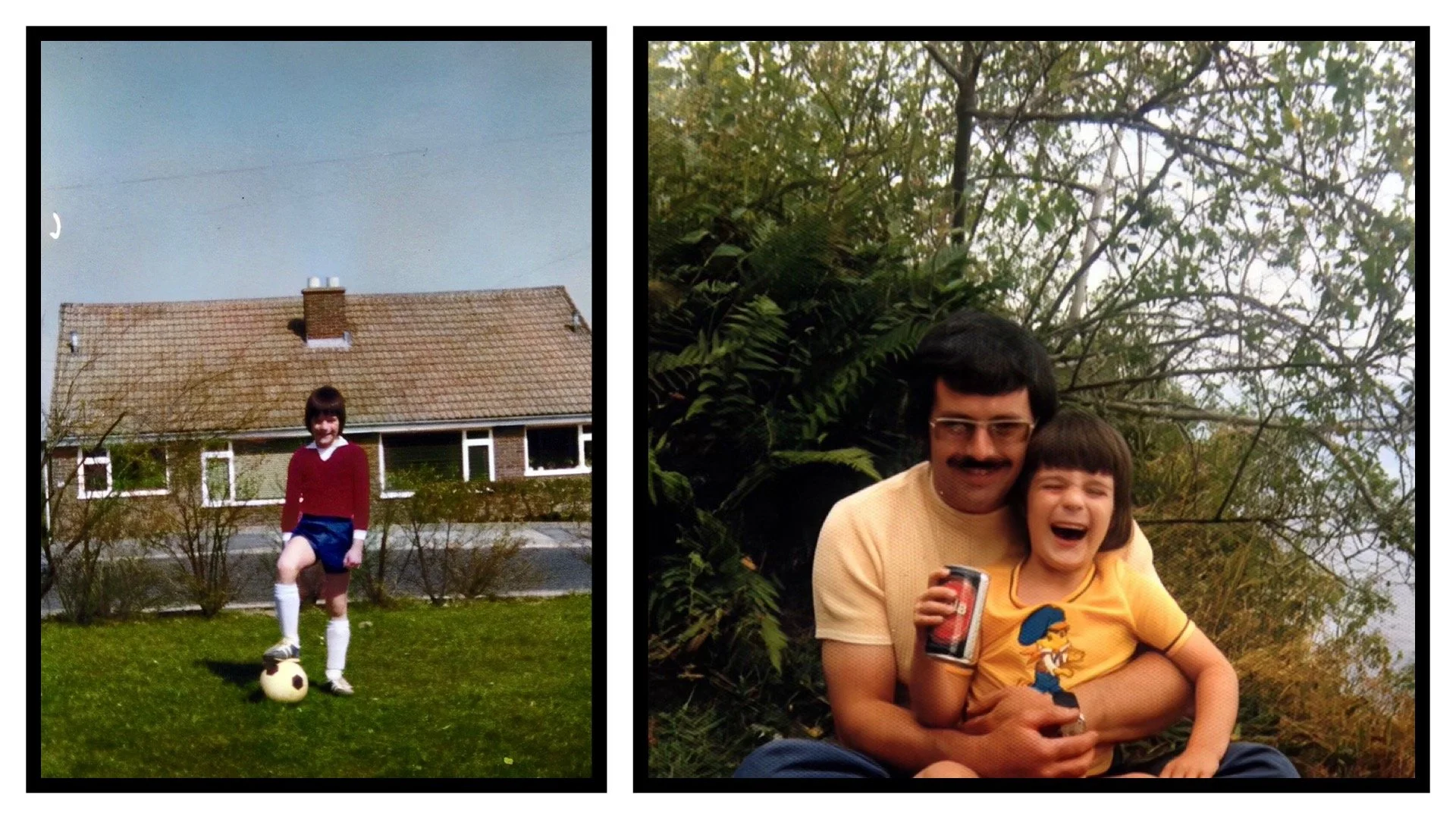
The Mid 70s snaps! (Images: Peter Wilkinson, Mary Wilkinson)
In the mid-70s I was at primary school, football-mad and navigating my way through a childhood where the summers were hot (1976!), Star Wars had us queuing around the block to get into the ‘Pictures’, a battle between punk and disco music was ongoing and whilst the television was limited to three channels, there was never a shortage of good stuff to watch (Multi-Coloured Swap Shop, Grange Hill, Six Million Dollar Man, The Muppet Show, Happy Days, Doctor Who and Top of the Pops, to name but a few).
All accompanied by sugar confectionery treats such as Texan bars, Spangles, Pacers, Chewits, Space-Dust and Toffos (original, assorted and mint!), as well as pre-shrinkflation properly-sized Mars, Topic and Marathon (Snickers) chocolate bars.
And obviously washed down with a "Lipsmackin' thirstquenchin' acetastin' motivatin' goodbuzzin' cooltalkin' highwalkin' fastlivin' evergivin' coolfizzin' Pepsi!”
As the Wrangler jeans advertising campaign of the late 70s memorably declared: “Good grief, Rickenbacker.”
Track 1: Side A, Track One (The Early Years)
But music soon took centre stage for me, around about 1978.
And it manifested itself in the unlikely guise of The Boomtown Rats. Whilst playground talk focused incessantly on John Travolta and Olivia Newton-John’s Grease or Sister Sledge’s latest single, I was led down a different, more rugged, Bob Geldof path, and snared by “Rat Trap”, which became my first ‘proper’ 7” single purchase (I’m purposefully ignoring any Showaddywaddy or Wombles Christmas LP ‘gifts’ from previous years!).
“I was caught in a rat trap, no less.”
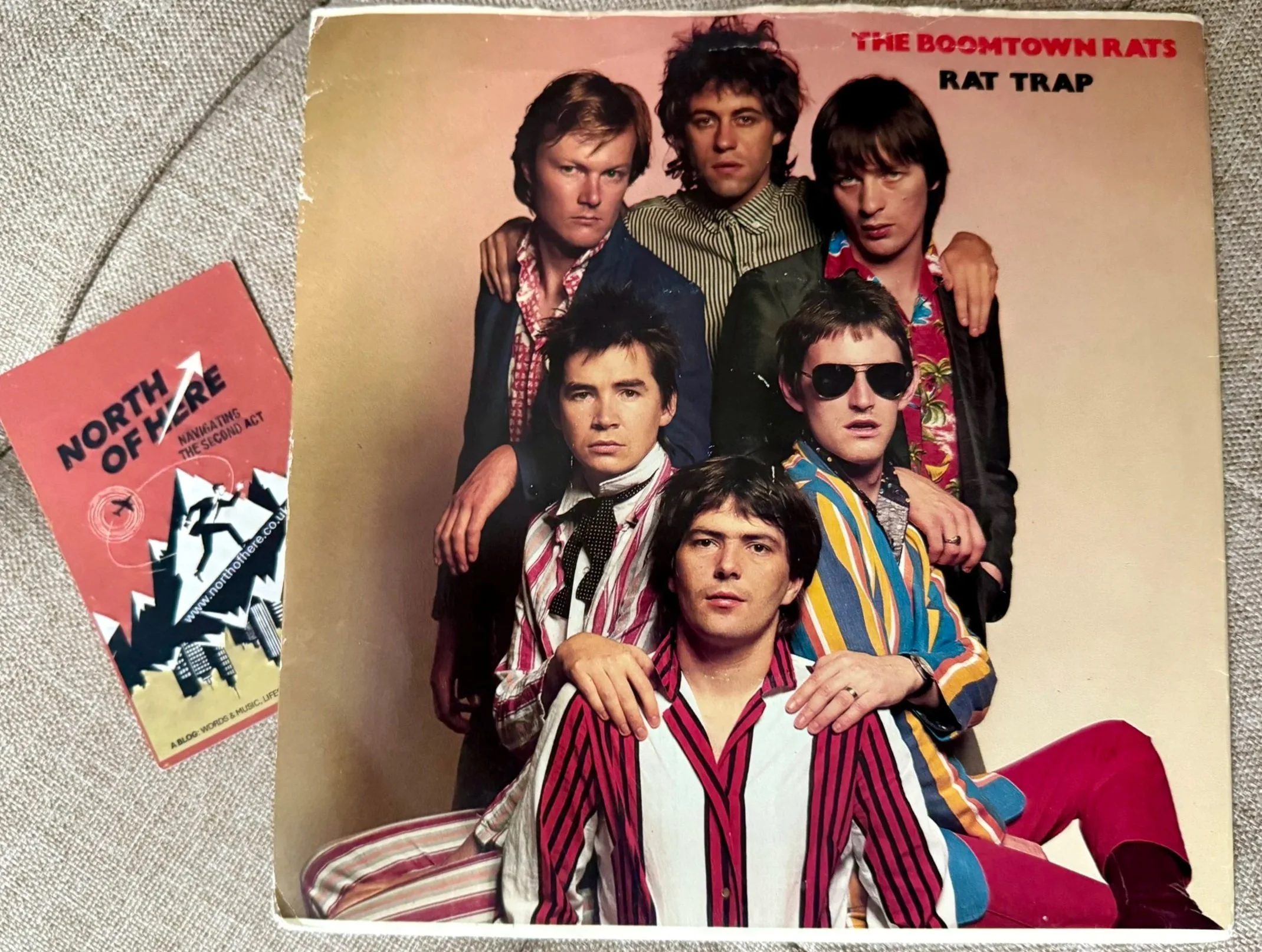
The 7” single that snared me - Rat Trap, The Boomtown Rats (Image: Damien Wilkinson)
Given his own obsession with music, my Dad obviously took an interest in what his 9-year-old son was listening to, and soon helped add some ‘oomph’ to my solitary record collection. More Rats singles and the album “Tonic for The Troops” were supplemented by hits from The Police, Blondie, Madness, Meat Loaf and others. Indeed, my Dad was unafraid to venture slightly outside the norm, with Dave Edmunds “Queen of Hearts” Pub-Rock classic 7” single being an interesting, but well received, choice for this primary school pupil.
A further rock ‘n’ roll pointer came from a very unlikely source, namely McVitie’s Digestive biscuits - my Dad was an avid connoisseur of the dark chocolate variety (though, to be fair, the milk chocolate counterparts would never be turned down either).
Tooth-decay notwithstanding, we managed to munch our way through a sufficient quantity of the chocolate-coated-wheaten-discs, collecting enough wrappers to be rewarded with Volumes 1 and 2 of McVitie’s specially commissioned Rock Classics compilation tapes.
It’s no exaggeration that the music and artists from these humble cassettes took me in all sorts of directions, which I’m still furrowing, over 40 years later!
A case of Taking the Biscuit, if ever there was one!
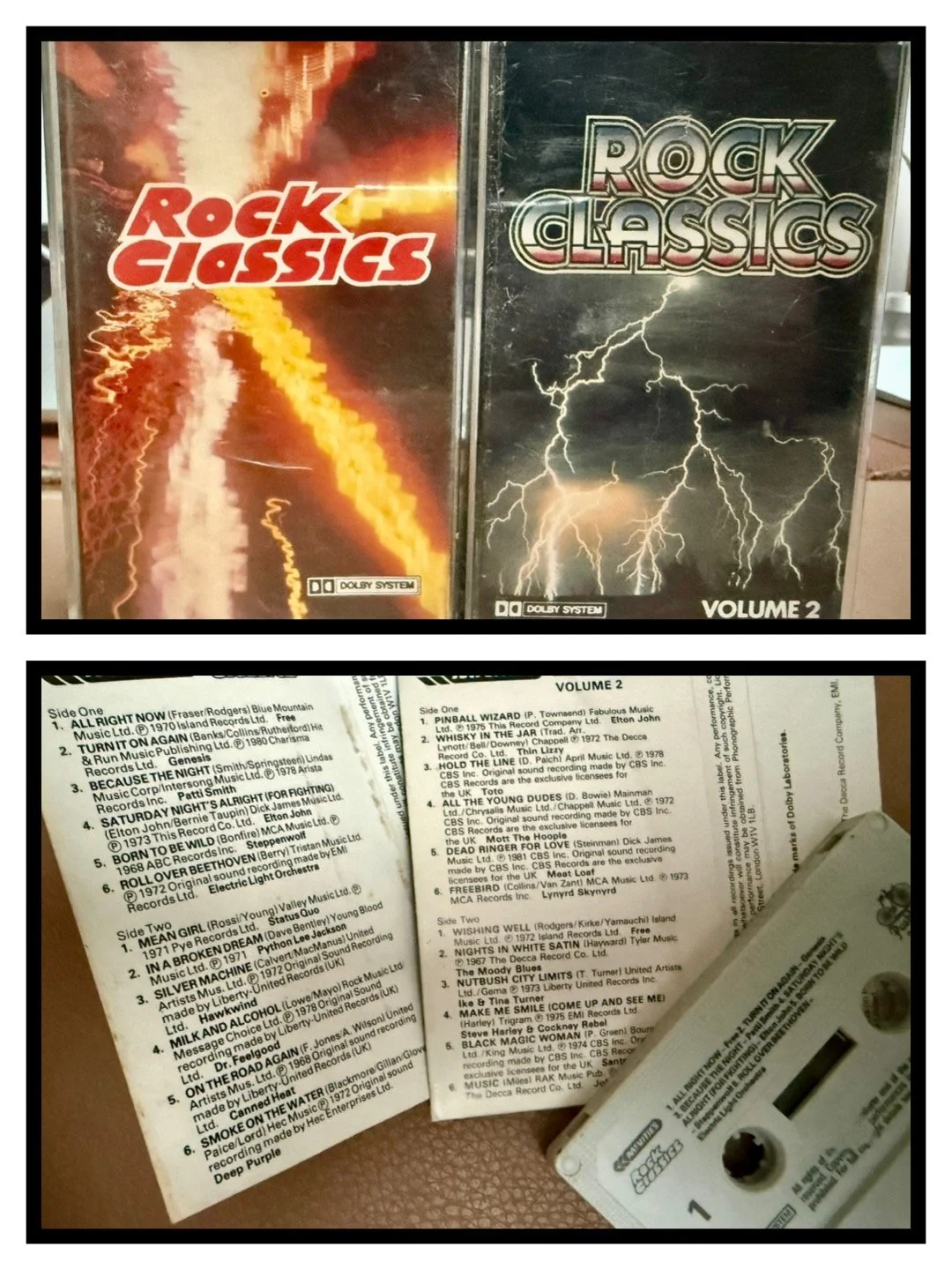
Taking the Biscuit: The early 80s McVities “Rock Classics” cassettes Volumes 1 and 2! (Image: Damien Wilkinson)
Track 2: The Keys to the Engine (The Dynatron)
It wasn’t long before I was handed to keys to the engine, through a time-honoured hand-me-down.
A 1970s Dynatron sound system: teak casing, smoked Perspex lid, and a Goldring turntable.
Textbook.
With its array of sliding dials, pop up and down buttons and glowing lights, I wasn't just playing a record; I was piloting a major exploration into the world of optimum bass and treble, as the diamond tipped stylus landed on the platter.
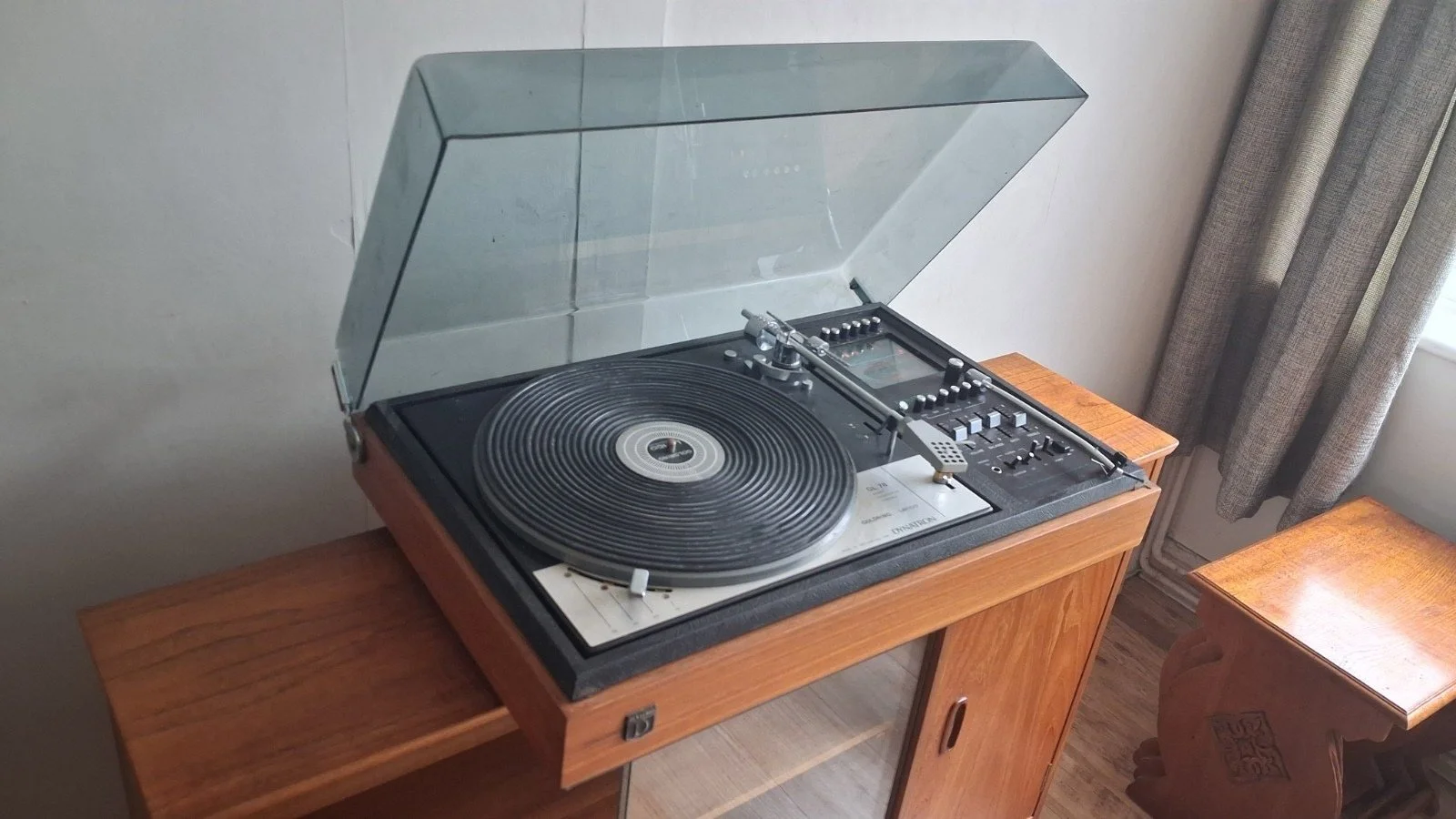
DYNATRON Goldring GL-78 (Image: with kind thanks to Ebay seller Jonah4003)
It was soon joined by an Amstrad Model 7000 tape deck, a piece of kit that brought a legitimate recording studio vibe to the setup. With its sleek sliding faders, dual Left/Right VU meters, and Dolby NR, it felt like high-end gear and was worth its weight in gold.
It became the ultimate creative hub for:
Radio Hits: Perfectly timing the Sunday Top 40 to cut out the DJ’s voice.
Custom Mixes: Diligently archiving vinyl albums onto C90 cassettes.
Lo-fi Karaoke: Utilising the front-facing Mic slots for primitive vocal recordings.
However, it wasn’t averse to the odd "tape salad" moment. These mechanical mishaps necessitated much patience and the "surgeon-like-precision" of a Bic biro, as you delicately wound the mangled magnetic ribbon back into the spool, praying the crinkles wouldn't ruin your favourite track.
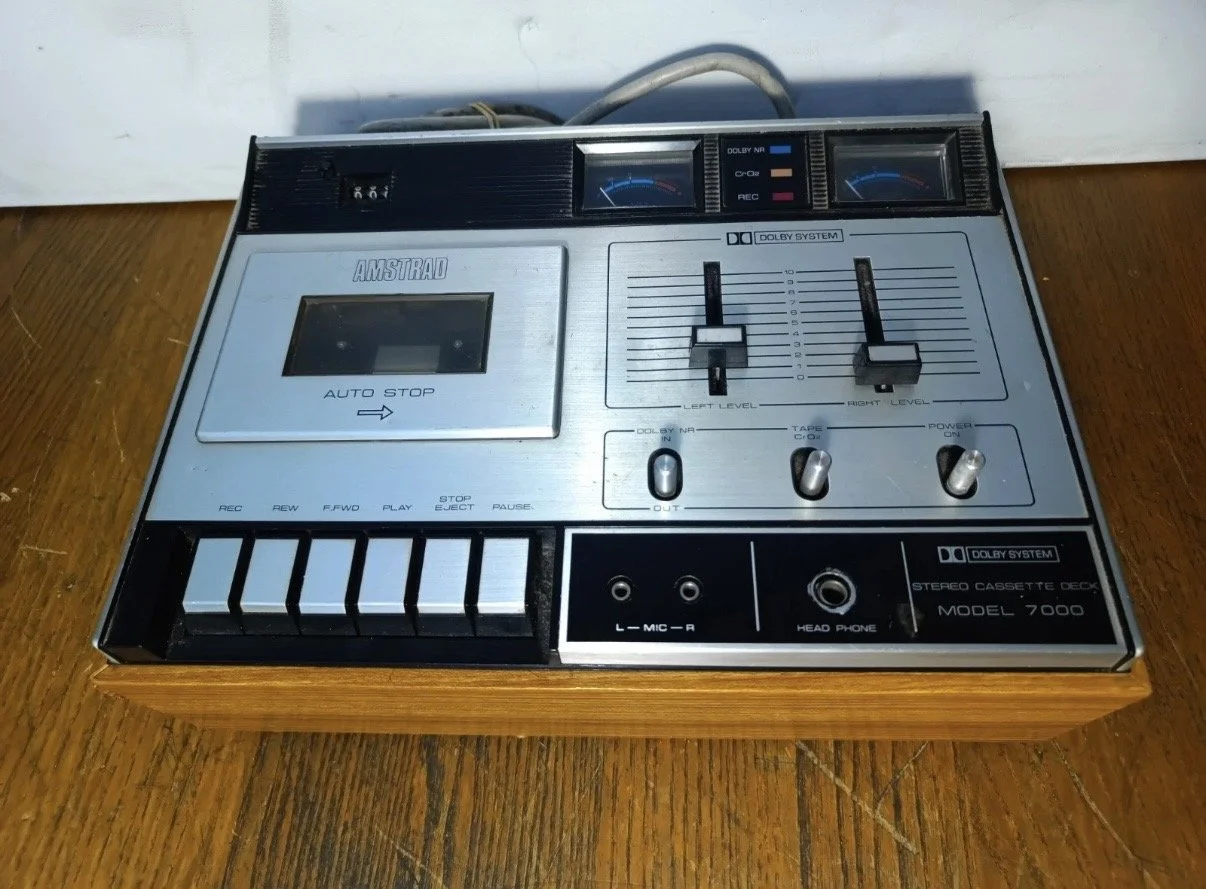
The Amstrad Model 7000 Cassette Deck (Image: Thanks to Ebay seller red-badger)
A Vinyl Explosion
Whilst my collection of vinyl expanded, as we moved into the 1980s and middle school, I also delved into the treasure trove of records making up my Dad’s own collection. This consisted of an eclectic mix, in no particular order of significance, of Irish folk (The Dubliners, The Chieftains, Planxty, Christy Moore), Country (Emmylou Harris, Johnny Cash) as well as more mainstream rock and roll (Elvis, The Rolling Stones, Bob Dylan, The Beatles, The Animals and Cliff Richard).
The Irish emphasis very much echoed our family heritage; my Grandma (Dad’s mother) grew up in Northern Ireland, we had relations over there - so we always felt a pull to the Emerald Isle!
The thrumming energy of Christy Moore’s kaleidoscopic anthem, “Lisdoonvarna”, soon became etched into my aural memory.
“Oh, Lisdoonvarna, Lisdoon, Lisdoon, Lisdoon, Lisdoonvarna!”
While much of Dad’s collection was initially off-putting to my young ears, I soon fell into a lifelong obsession with The Rolling Stones. This devotion was fuelled by the myth-heavy biographies nestled in the bookcases nearby; I devoured the rock ‘n’ roll folklore of the Stones, The Beatles, and Elvis with equal fervour. The Stones, however, became the True North of my musical journey.
Surprisingly, The Beatles never sparked that same level of mania—at least not until the afternoon Mum collected me from middle school with the news of John Lennon’s assassination. We soon joined the sombre swell of the masses, purchasing 'Imagine' and propelled it to Number One.
Track 3: Quenching the thirst (The Bradford/Leeds record shop crawl)
Trailing around the many record shops of Bradford and Leeds soon became an obsession and weekly ritual.
Bradford back then was a treasure trove of mainstream record shops with an HMV, Our Price, two WH Smiths, Boots, Woolworths and even Littlewoods supplying a multitude of vinyl and cassettes.
Mining for black gold in Leeds involved Crash Records, Jumbo Records and Gerol’s Records in the Merrion Centre amongst many others. Remarkably, the first two of these are still thriving today!
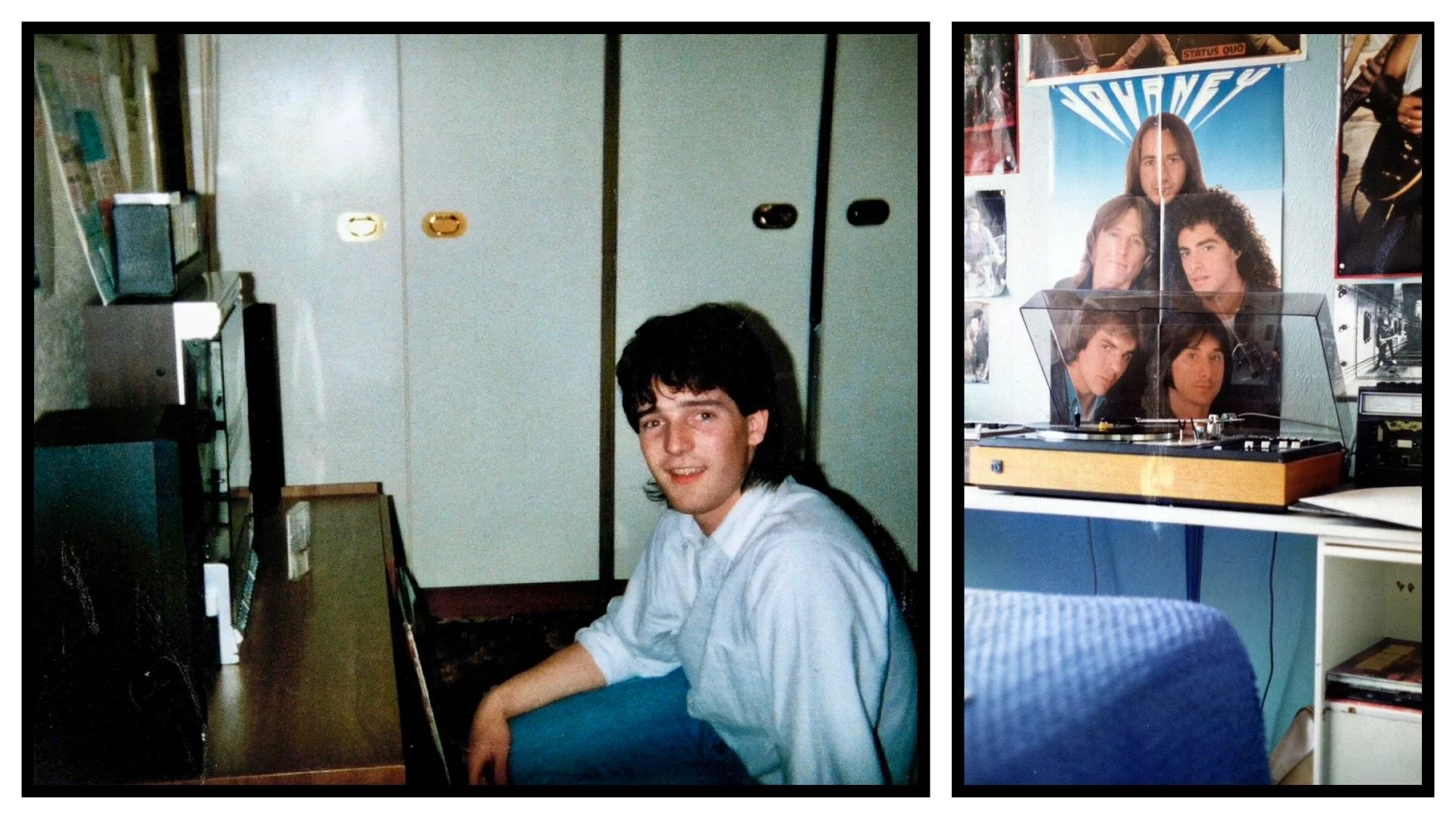
The 80s Bedroom years: (left) The Amstrad SM104 vertical record player, (right) the Dynatron music system (Image: Peter Wilkinson/ Damien Wilkinson)
Back in Bradford, the much-missed Rocks Off, Wax Museum (later re-named Discovery Records) and Bostock’s Records, were independent outlets that provided a bit more depth, tarnish and off-grid content whilst remaining more wallet friendly. Of course, that didn’t completely quell the desire for music, so any visit to town would be complemented with a visit to the Record Library to get the weekly ration of 3 album ‘loans’.
“Flipping through the sleeves released a heady, paper-dry aroma - a perfume of ink and cardboard that felt as heavy as the records themselves.”
Today’s digital immediacy can’t replicate the tactile thrill of flicking through dusty, plastic-sleeved vinyl. There’s an art form in the searching through the racks; you eventually develop a high-speed intuition, recognising iconic covers from a mere glimpse of the top edge. Then comes the ritual — the delicate slow pull and removal from the sleeve and the forensic scan of the grooves for dust, scratches, warps, or wear.
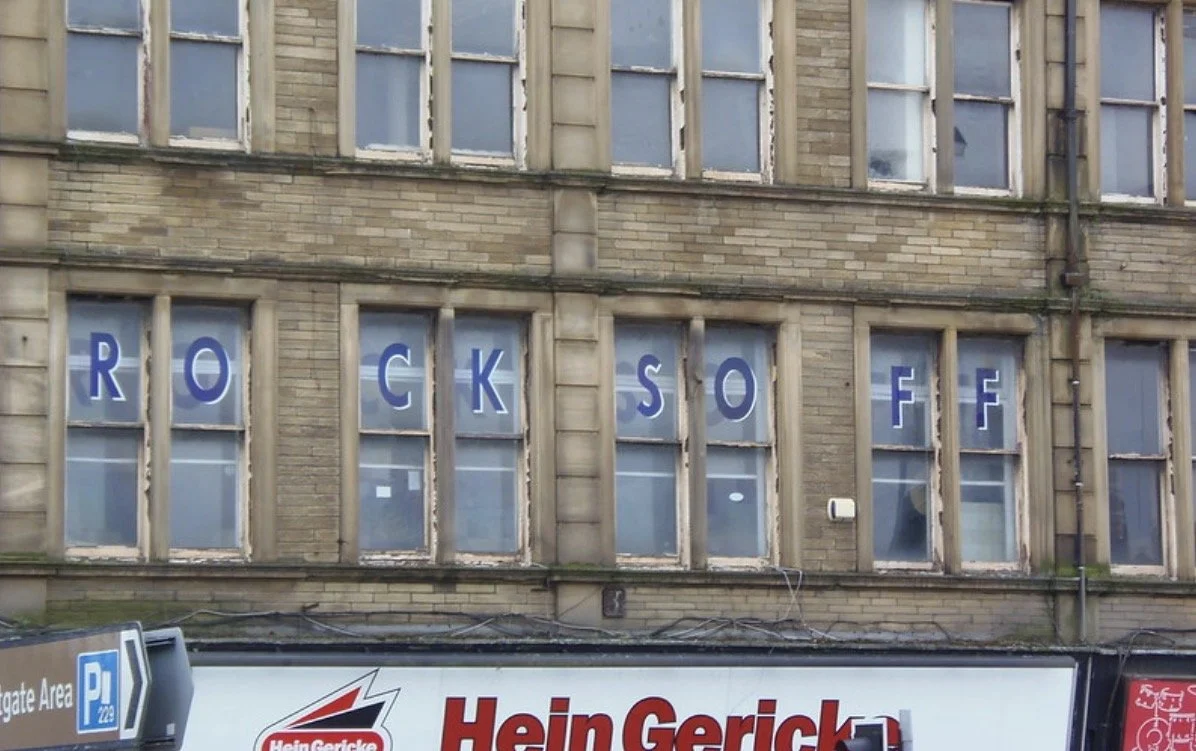
Rocks Off Record shop, Bradford (Image: Kieran Wilkinson)
My Dad accompanied me on many of these weekend trips and before long I had an HMV carrier bag almost permanently attached to me, back in those halcyon days.
Track 4: A Denim Affliction (Quo and the Spa)
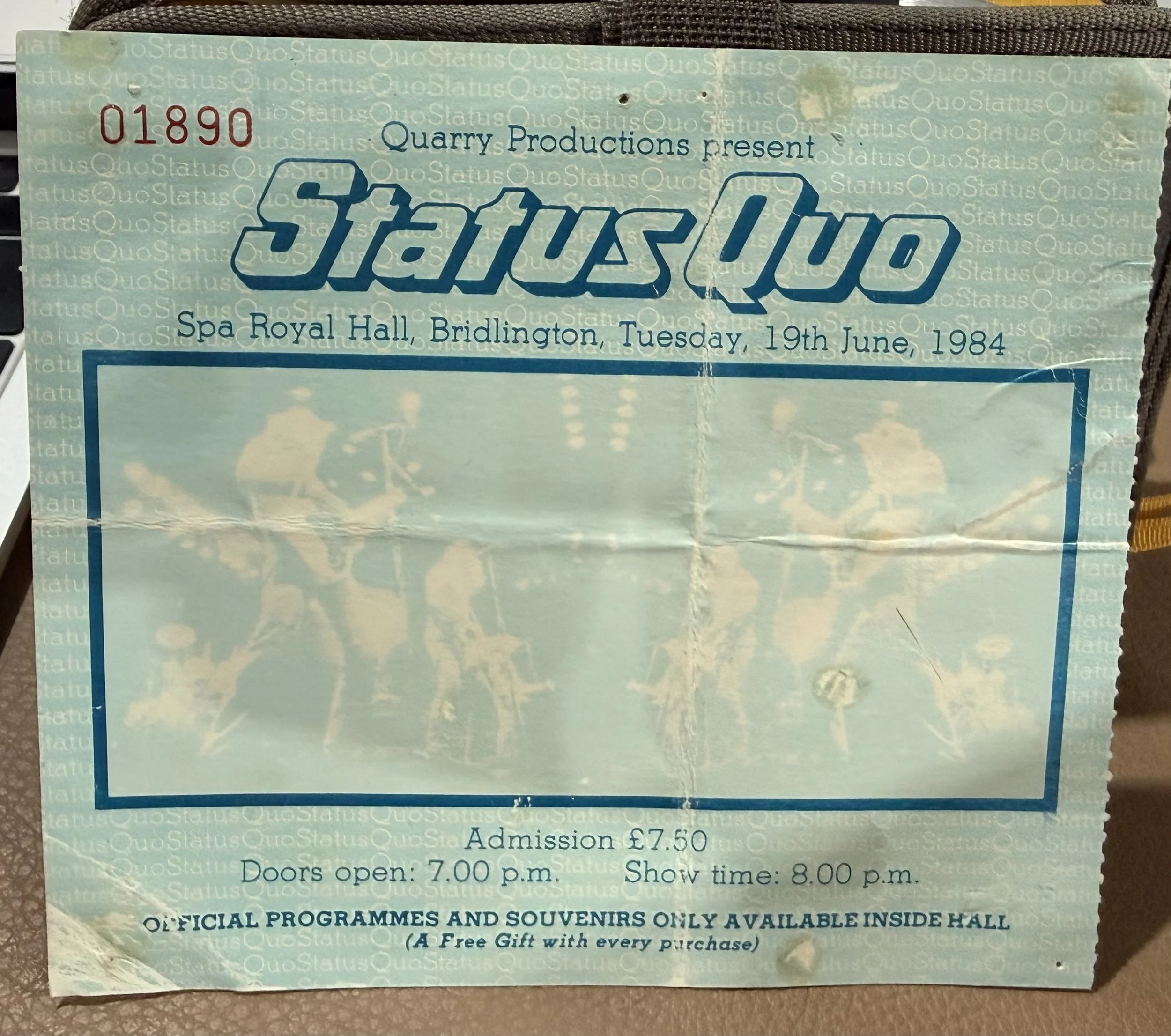
My First Ever Gig! Status Quo, 19th June, 1984 (Image: Damien Wilkinson)
For a while my music education ploughed its own furrow, a 1980-81 dalliance with Antmania as Adam & the Ants reigned over the Wild Frontier, followed by a not overly surprising excursion for a teenager, into the world of Heavy Metal and Prog Rock. With Tommy Vance’s Friday Rock Show adding some radio-controlled direction, this gathered further momentum in 1982 with the purchase of Status Quo’s “1982” album and the start of a long-standing denim-clad Quo affliction, cemented by my first ever gig to see the Quo in 1984 at Bridlington Spa Royal Hall. Naturally my Dad, Mum and four year old brother, ferried me and my next door neighbour, Steven, over to Bridlington, so I didn’t miss out on the gloriously ill-titled “End of the Road” tour!
It was an experience like no other.
“Halfway through the set, we moved from the stalls to the balcony for a better vantage point. Incredibly, we were hoisted onto a trestle table tucked against the side railing. We spent the rest of the night bouncing rhythmically on the tabletop, looking nervously over the ledge at the stalls below while the Quo belted out their set at a deafening roar”
It was the glorious, lawless dawn before Health and Safety took hold!
Track 5: Joining the Dots (the Boss and the Irish Connection)
1985 saw Bruce Springsteen reach superstardom with his “Born in the USA” album and I was reeled into the world of the Boss by my uncle (my Dad’s brother, Paul) who suggested I give the album a listen, kindly buying me the cassette version.
I was soon hooked and, before I knew it, was attending my second gig at Roundhay Park, Leeds, to witness the Boss roll into town with his E Street band.
Again, another long-term compulsion ensued (I’ve also weaved this into my blog about E Streeter Nils Lofgren A Rhythm Romance with Nils Lofgren).

The Springsteen Born in the USA sleeveless T-Shirt, July 1985 (Image: Peter Wilkinson)
Around this time my Dad turned my attention to The Pogues, being an early adopter of the “Rum, Sodomy and the Lash” LP, which again further opened my eyes and ears to Irish music.
We also took an early rock and roll heritage trip, seeing the re-union of The Everly Brothers at Harrogate Conference Centre in November 1985, where I proudly displayed my Springsteen t-shirt! The gig also led me to investigate the excellent session guitarist Albert Lee (Heads, Hands & Feet, Emmylou Harris’ The Hot Band, and many more), who I later saw play at the legendary Breedon Bar in Birmingham in 1989, and further gigs thereafter.
In some ways it was almost like my Dad was throwing out co-ordinates to me and I was joining the dots of where it could take me musically!
Home Taping is Killing Music
Much of this direction and sharing, especially with the Walkman providing much support, would take the form of home taping onto our arsenal of blank C90 Cassette tapes. Handy for squeezing a couple of albums on either side, it was a great way to secure initiation, and whilst not quite a Mix Tape, was compiled with some thought and care - handcrafting an inlay card certainly became an art form in itself (the photocopier at Dad’s work also earned its corn here!).
Despite the music industry warning us that “Home Taping is Killing Music”, for me it had the opposite effect, opening my ears to appreciate a much greater landscape of artists and thereby “saving music” through subsequent purchases of their work.
During the mid 80s my record player even had an upgrade of sorts - a swanky new state-of-the-art Amstrad SM104 Vertical Record player with twin cassette decks and radio. It also offered ‘tape-to-tape’ recording possibilities which pushed the envelope out. Whilst sadly it lacked the sonic tone and sweetness of the Dynatron, and vinyl had an annoying tendency to ‘jump’ at the slightest movement, aesthetically it seemed to fit right into the Max Headroom vibe of that time.
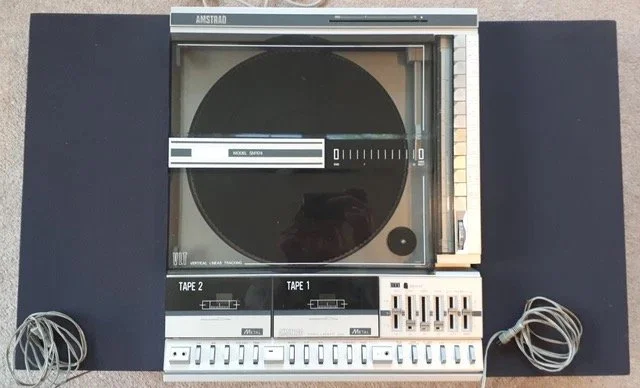
Amstrad SM104 Vertical Record Player system (Image: eBay giant.impact.retro)
The Sixth Form and Uni days
As I went through sixth form, my musical tastes moved into a more mainstream rock direction with Queen, Genesis, Dire Straits, Peter Gabriel, Marillion, Magnum, Def Leppard and many, many others receiving significant airplay around that time. Not to mention many coach trips to gigs around the North and beyond, courtesy of Cavendish Travel of Bradford.
University followed, and my musical education moved to the Midlands. Birmingham provided a fresh hunting ground of record shops (Reddington’s Rare Records, The Plastic Factory) and sweat-soaked gig venues (The Hummingbird, The Irish Centre, Edwards No. 8) to explore.
Eschewing a lot of music that might be expected for a student to listen to, I circumvented the Madchester era, instead reaching out into all sorts of musical avenues. For example, Bruce Springsteen had led me to Nils Lofgren, who then led me to Neil Young, who provided a gateway into country music and before I knew it, I was led back into my Dad’s music collection and artists such as Emmylou Harris, The Flying Burrito Brothers, Gram Parsons & the Fallen Angels, Rodney Crowell, John Prine and Linda Ronstadt.
The Georgia Satellites, with their “Louder than Hell” Southern-tinged rock ‘n’ roll anointed the above and led to a memorable post Nottingham Rock City gig overnight sleep in a shop doorway (documented in a subsequent memoir blog!!).
This was back in the Google-free days when I’d pore over every inch of the album notes, lyrics, and credits. These fine-print details acted as a treasure map, signposting even further journeys into the obscure through the musical networks they revealed.
I’d always study my Dad’s music collection of vinyl, cassettes and now CDs, looking for that classic I might have missed or keeping an eye out on any new additions he might have snuck in since the last time I had looked.
Furthermore, Dad-directed music “pointers”, included the excellent folk singer-songwriter, Arlo Guthrie (son of US folk icon, Woody), where my Dad had apparently acquired Guthrie’s entire 70s album output, not available in the UK, via a cheeky letter request to the US label’s headquarters, who responded very generously by shipping them over to him!
Those were the challenging days when it was difficult or massively expensive to source any Stateside only releases.
In a similar vein, Steve Earle and The Long Ryders were other artists where my Dad had chanced upon debut albums that sparked interest for us both, and were great in-roads into both artists and the burgeoning Americana movement around then, with a diversion for me via the college rock of R.E.M., roots rock (The Rainmakers, The BoDeans) and the Paisley Underground scene and bands such as Green on Red.
Dad was a long-standing fan of Christy Moore from his work with Planxty and solo work in the 70s. I’d heard much of his output vicariously, but with my newly expanded mind/ear-set I was now drawn into his work, propelled again by my Dad when he took us to see Christy play at Leeds Irish Centre in 1986 (and yes, he played Lisdoonvarna!)
We even got to see Arlo Guthrie on a rare tour of the UK in 1988, revisiting his 1967 hippy classic “Alice’s Restaurant Massacree” at The Royal Hall, Harrogate of all places!
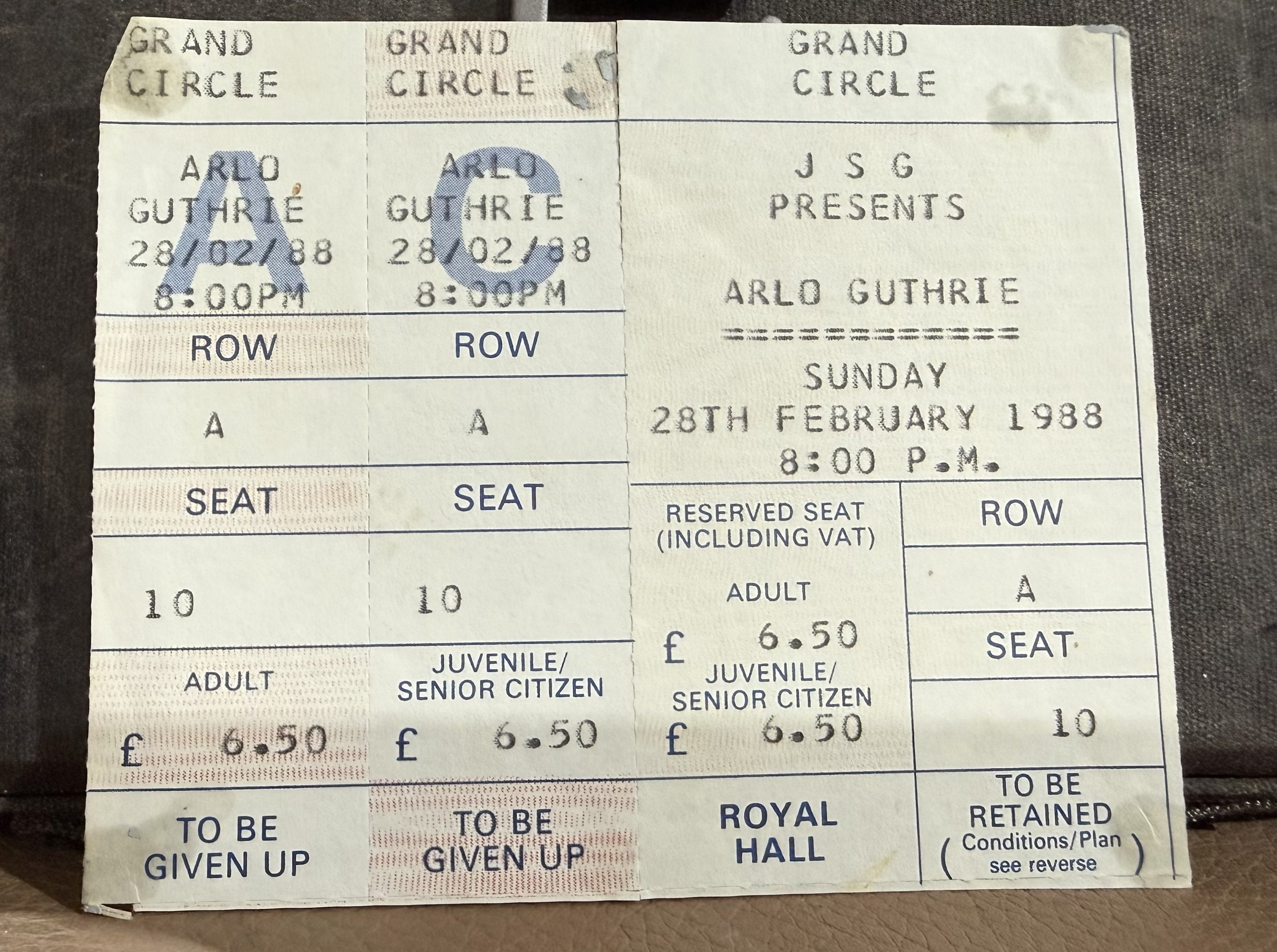
Arlo Guthrie, Harrogate Royal Hall, 1988 (Image: Damien Wilkinson)
Flipping on to the B side
In a poacher turned gamekeeper moment, after years of enduring the strains of the Quo filling the house, my Dad even gave in and ended up going to see them in concert with my brother, who was also following a similar path of musical tutelage from Wilkinson senior.
This reverse-osmosis also seeped into albums. One of my favourite albums, John Mellencamp’s “The Lonesome Jubilee”, diverted the rocker into a more organic and rootsy direction, the fiddle infused rock songs representing a cross-over that now resonated more with much of the music in Dad’s world.
I circled back to Dad’s Gram Parsons collection—specifically the “GP” and “Grievous Angel” albums—as many of the bands I was into were now championing the country-rock pioneer through covers, tribute albums, and constant name-checks. My Dad had been ahead of the curve all along!
The Waterboys “Fisherman’s Blues” and “Room to Roam” Celtic folk forays were perhaps more obvious, but equally powerful crossover examples, again dispelling any misguided pigeonholing or separation of our respective musical libraries.
The New Millennium
In later life, music was always a common bridge with my Dad, sharing latest bands, albums and still attending some gigs together. Again, also now with my brother, we even got to see Arlo Guthrie for a second time in 2010 at the splendid Holmfirth Picturedrome.
It was often joked that my Dad had Johnny Cash albums that even Johnny Cash couldn’t remember recording, and I gained a foothold and commonality with Dad through the much heralded Rick Rubin produced “American Recordings” albums, that Cash recorded in his latter years. Another passion ensued right then, with another extensive back-catalogue to plunder.
The Death of the CD and the download era
The biggest change in the last twenty years or so was the death of vinyl and tapes and the growth of CDs as the main listening medium. I followed suit, selling off a lot of my vinyl and embracing the shiny CD format, amassing an extensive collection along the way.
The amount of times I’ve re-purchased certain albums (vinyl, cassette, CD, minidisc, re-issued, re-mastered ‘special’ anniversary editions, and new, improved, supercalifragilisticexpialidocious vinyl versions) is somewhat staggering, whilst also flagging me as the ultimate marketing victim!
Record shops sadly dwindled around this time. I recall visiting Discovery Records in Bradford during its closure in 2012/2013 after almost 30 years of service. Whilst buying a CD copy of Quo’s “Dog of Two Head” it suddenly dawned upon me that the vinyl version was amongst the first ever purchases I made from the same shop when it opened in 1984! This wasn’t lost on owner, Kaz, who was literally moved to tears when I recounted this near 30-year-old recollection!
But, somewhat bizarrely around this time saw the vinyl format begin to experience an unlikely rise from the grave, and I eventually rekindled my vinyl collection, taking advantage of the availability and cheap cost of many albums dating back to the 60s and 70s. Accordingly, I re-lined my collection with some wonderful artefacts from Dylan, The Stones and The Beatles, Neil Young, Cheap Trick, AC/DC and Billy Joel.
“The tactile nature of the vinyl format—from the weight of the disc to the elaborate packaging of the late 60s and 70s—creates a 'time-capsule' aesthetic that frames the music as a physical piece of history”.
And they sounded pretty good too – the odd crackle and pop as the needle made it way through a mono version of the classic double album “Blonde on Blonde”. seemingly adding to Dylan’s vibrancy and authenticity.
A lot of my focus was on the period from 1967-1972 which is one of my favourite periods of rock music, punctuated by many classic albums from all of the big hitters.
I eventually reached a crossroad of sorts when, having digitised most of my CD collection (creating something in the region of 80,000 tracks on iTunes), I was left with literally thousands of CDs that (a) I had nowhere to put and (b) were never going to be listened to again.
Cue a fortuitous visit to a record shop, literally on the doorstep of where I was living, with a plea for help! Thankfully, John of the mighty 5 Rise Records in Bingley, was able to answer my cry for salvation, and we were able to humanely off-load my collection* with most of them managing to be re-homed with musically matched recipients. Not so much a financial consideration but the avoidance of the emotional pain of seeing my former prized possessions in the 10p charity shop bucket. For my own ‘closure’ purposes it became a “curated hand-off” rather than a disposal.
You’ll be relieved to hear I kept hold of ALL of my vinyl!
*actually, I kept hold of all my CD box sets, but don’t tell anyone!!
Track 6: The Long Play Legacy (Sharing the Map)
From 2000 onwards my musical journey collided in a good way, with the birth of my daughters.
I’m pleased to say the musical maps have been shared and passed down to both of them during this time and I’m even prouder to see them with a completely uninhibited ear for bands and artists, new and old.
Being a devoted die-hard Stones fan I had somewhat put The Beatles to one side during my formative years (taking the “are you Beatles, or are you Stones?” directive very literally), but, giving them a renewed, deep-dive investigation, I soon realised—and corrected—the error of my ways, whilst also educating my girls in some of the most influential music of the last sixty years.
We’ve shared many gigs together including Madness (several times!), Paul McCartney, Genesis, Billy Joel, Bob Dylan, Queen, Patti Smith, Roger Taylor, Little Steven & the Disciples of Soul and Bruce Springsteen to name but a few.
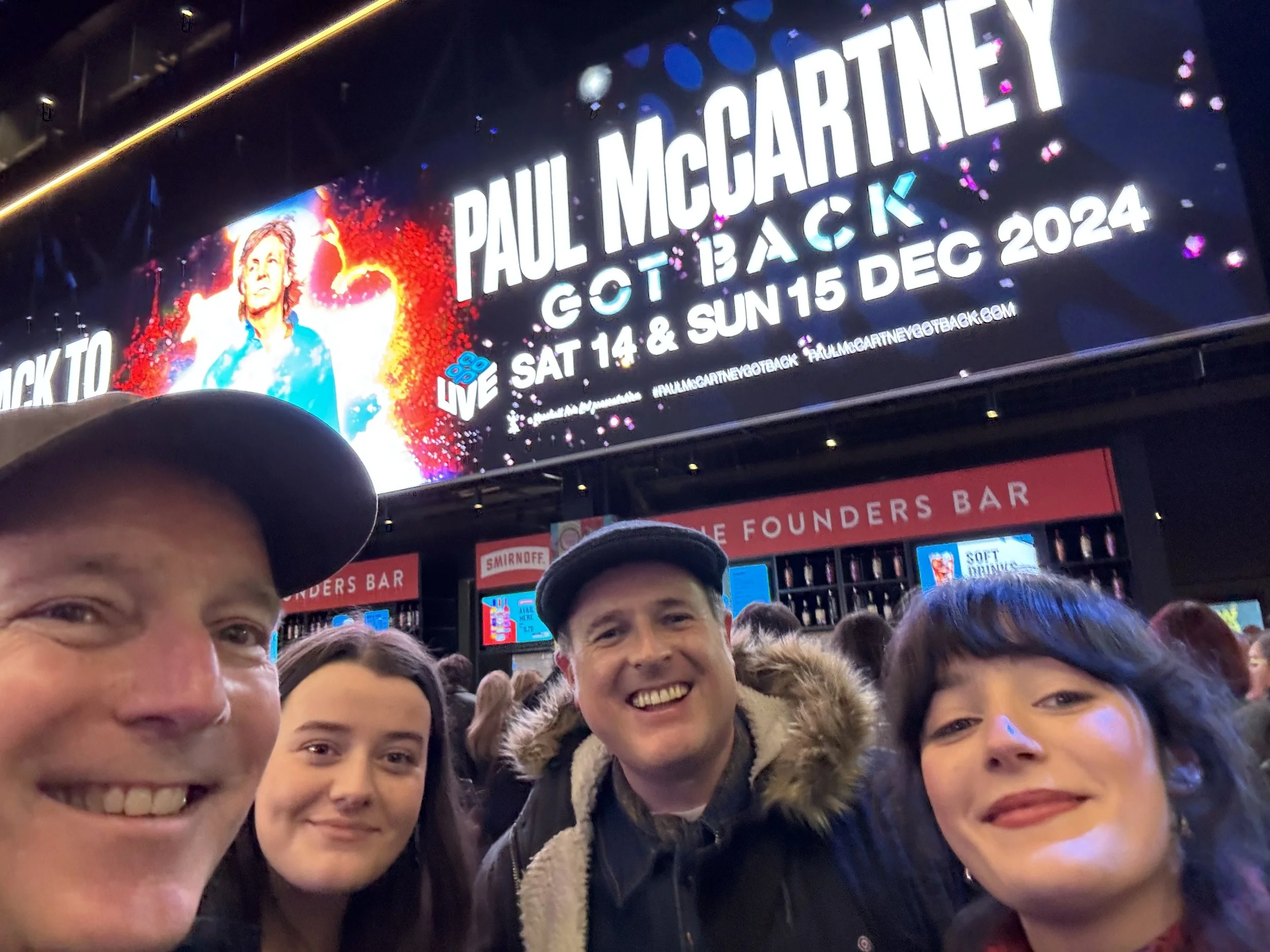
The Wilkinsons on Tour, Co-op Live, 15th December, 2024 (Image: Damien Wilkinson)
I’ve still retained my insatiable appetite for music. The emergence of downloading and streaming, whilst having limitations in hi-fi quality and lack of physical feel and content, has again widened my tastes, firing off into Jazz, Reggae, Neo-Classical, EDM, Death Metal and even, much to my daughters’ amusement, Taylor Swift and Lana Del Rey!!
Americana, Country, and Celtic Rock still cast long shadows over my listening habits. I’m constantly finding new branches on the tree my Dad planted, from the experimental grit of Wilco and Jeff Tweedy to the street-wise storytelling of Chuck Prophet, Jesse Malin, and Jenny Lewis. Even the high-octane energy of The Dropkick Murphys finds a home alongside more local heroes like Ian McNabb, Ian Prowse, Ginger Wildheart and Ricky Warwick—all artists who’ve been busy building impressive, sprawling bodies of work while I wasn't looking.
I do get a buzz from the immediacy of being able to listen to what I want, right now, despite this lacking the thrill-of-the-chase hunting down of a mega rare 12” picture disc single.
Despite this, I have kept an escape route back to good old vinyl with the Audio-Technica Sound Burger!! A gloriously retro and portable bit of kit helps give the vinyl collection an outing from time to time.
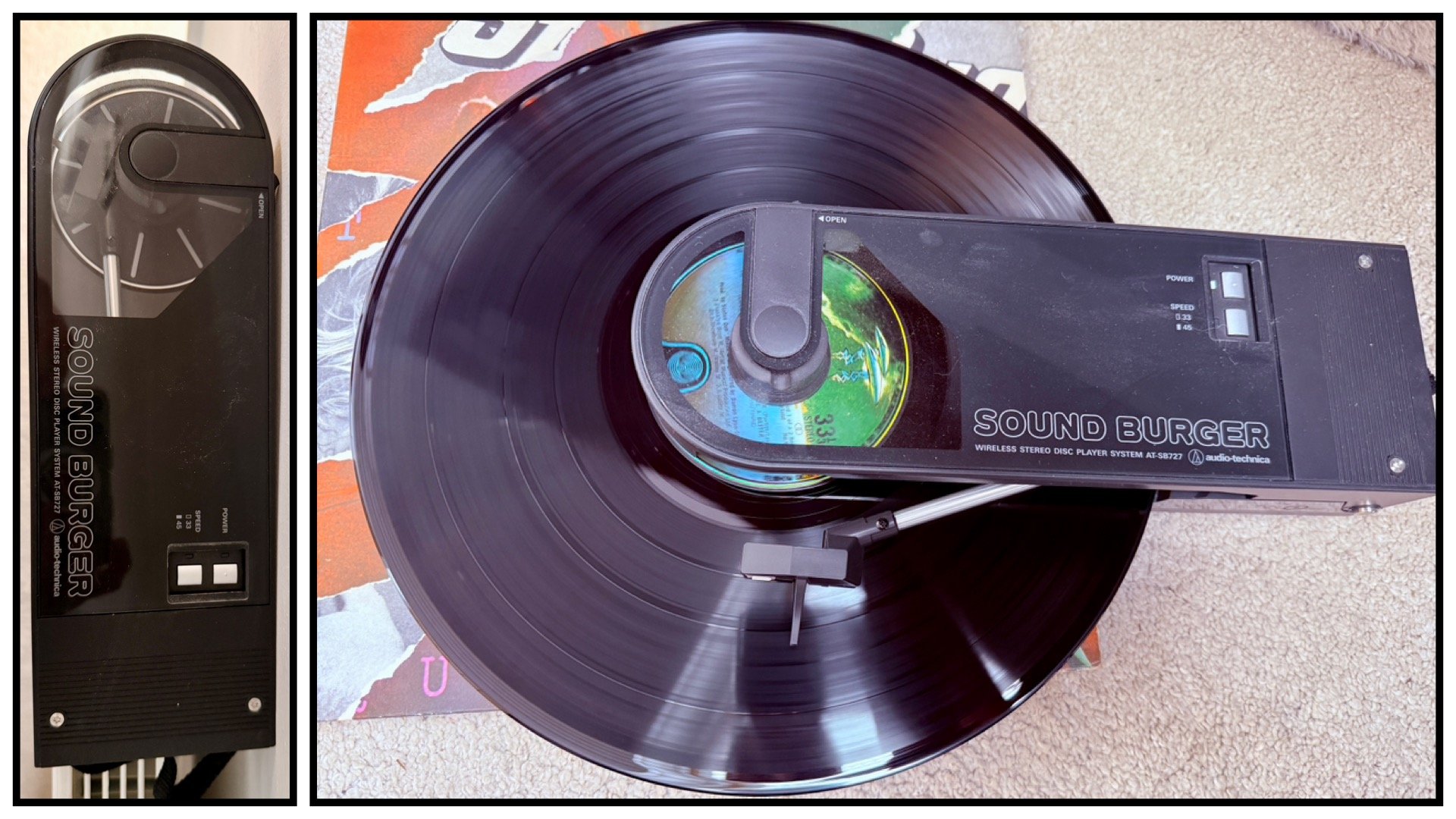
The Audio-Technica Sound Burger AT-SB727 (Image: Damien Wilkinson)
—————————————————————
My Dad’s needle left the record far too soon in 2011, but the memories of him, and particularly our shared musical wavelength, live on.
I’m constantly reminded of our mutual love of music in much of today’s listening, be it revisiting old classics, new discoveries or wondering what he would think of the latest output from Christy Moore, Bob Dylan, Steve Earle and all of the many others where our Stereos synchronised.
Looking back on our Father-to-Son musical legacy and writing about it has been remarkably restorative for me, helping contextualise my musical tastes and preferences, and most importantly, the role my Dad played in all of this.
There is really only one thing left for me to say:
I’ll keep the turntable spinning, Dad!

My Dad, 2009 (Image: Damien Wilkinson)
