
THE DEBITS & CREDITS: Claret, Amber, and the Passing of Time—A Valley Parade Ledger
The Backstory Archive: In the summer of 2015, I was asked to sit down and audit my life as a Bradford City supporter for The Width of a Post. The club was riding high on the fumes of the historic 2013 cup run and the miraculous 4-2 FA Cup dismantling of Chelsea at Stamford Bridge. Reading it back now, it reads like a snapshot of a man deep in the middle of his footballing life, measuring out his weekends in train timetables and pre-match pints. Eleven years later, looking back from the clarity of the Second Act, the ledger looks a little different, but the core coordinates haven't shifted an inch.
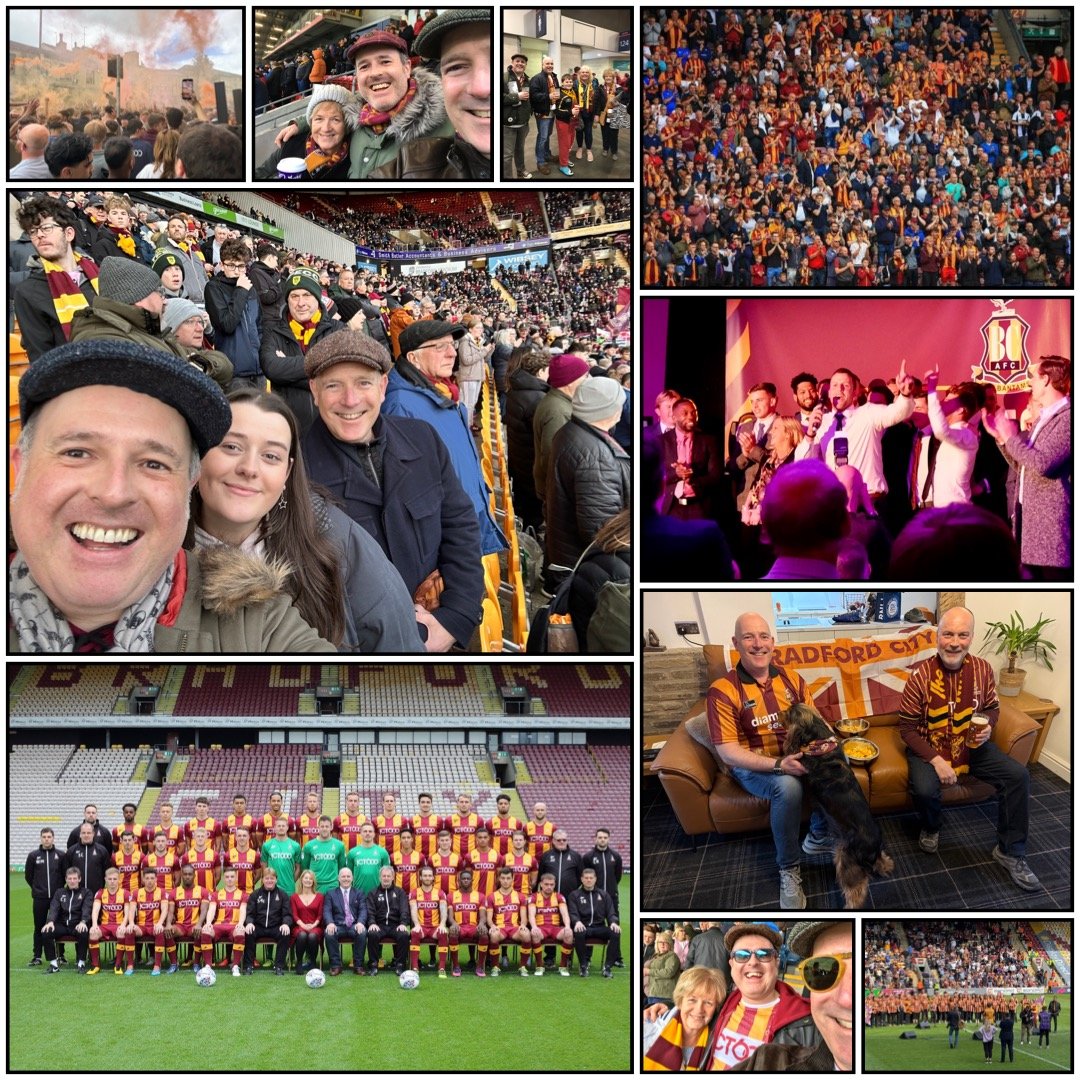
Various images over the years
The Accidental Conversion
Identity on the football terraces is rarely a straight line. Like many kids growing up on the outskirts of Bradford in the late 1970s, I initially succumbed to the glamorous, gravity-defying pull of Liverpool. They were the in-vogue European Champions; Bradford City were a highly unfashionable outfit drifting through the absolute basement of the Fourth Division.
My early allegiance was associative, not local. I vaguely remember my dad taking me across to Leeds to watch Liverpool play. I promptly endeared myself to the Elland Road faithful by cheering wildly when Liverpool scored. We were, unfortunately, sitting dead centre in the Leeds home end.
By the early 1980s, the grim, violent spectre of hooliganism had cast a dark shadow over the English game, and I fell out of love with football entirely. The turning point arrived with a sudden, beautiful jolt in 1986. It was an impromptu visit to Valley Parade to watch City dismantle Oldham 5-1. The spark was lit. At the start of the infamous 1987/88 "Nearly Season," my dad took my younger brother Kieran and me to find our bearings in the Midland Road stand.
Despite the fact that the season coincided with me leaving for university in Birmingham, the bug bit deep. We were caught in the slipstream of a memorable, heartbreaking year. I’ve never looked back. I succumbed to the permanent gravity of a season ticket in 1996, eventually cranking things up to follow the club across the country on the away ends.
The Dales Commute
Geography dictates the ritual. Living across in Hellifield, tucked ten miles north of Skipton in the rugged quiet of the Dales, getting to a home match requires a proper pilgrimage.
For years, the ideal Saturday scenario followed a strict, comforting rhythm. I’d catch the train down into Bradford for around 1 PM. The pre-match nerves were traditionally settled over a few pints in Haigy’s, soaking up the collective anxiety of the crowd. Post-match, it was a swift, celebratory (or consoling) pint in the Midland Hotel on the walk back to the station platforms, catching the train back north as the dusk settled over the hills. For the away days, the reliable sanctuary of the Shipley Bantams coach became my window to the rest of the footballing map.
You watch enough football over thirty years and the names begin to blur, but certain figures become permanent fixtures in your internal hall of fame. Stuart McCall and John Hendrie are the bedrock, of course. But for me, Robbie Blake occupies a special pedestal.
During his peak years, I was still playing a fair bit of local amateur football myself. Watching Blake was an education. He wasn't blessed with raw pace—a limitation I deeply identified with—but the phrase "the ball was glued to his feet" was practically invented for him. He possessed a rare, mercurial ability to conjure a goalscoring opportunity out of an absolute vacuum, combined with a venomous, unexpected shot. He was pure entertainment.
On the broader stage, my memory banks still hold the vintage genius of Kenny Dalglish, the tragic brilliance of Paul Gascoigne during the heat of Italia ’90, and Alan Shearer’s ruthless, machine-like consistency during Euro ’96.
Escaping the Baying Hordes
The grounds you visit shape your map of the world. Because of my university years in the Midlands, Villa Park will always feel like a proper footballing cathedral to me—steeped in traditional brick, character, and noise. More recently, the away end atmosphere at Preston’s Deepdale has provided some of the finest, loudest afternoons on the road.
And then, there is Elland Road.
History has a cruel habit of repeating itself. In 1990, I found myself back in the Leeds home end for a Yorkshire derby. I managed to keep my emotions under lock and key for the bulk of the afternoon, but when Brian Tinnion stepped up in the final minute to smash home a point-saving penalty for Bradford, the dam broke. The sheer, unadulterated joy was too much to contain. A few of us had to literally escape down onto the pitchside track and flee down an exit tunnel to escape the baying local hordes.
At the other end of the aesthetic scale sits Accrington Stanley. The ground is a throwback to an older, leaner era, but my memories of it are permanently stained by some of the most shocking, abject team performances of the Peter Taylor and Peter Jackson eras—the kind of character-building misery that only lower-league football can provide.
The Highs and the Dross
People often point to our brief, dizzying ascent into the Premier League in 1999 as the peak. While that first survival season was incredible, it was the 2013 "History Makers" campaign that truly defined what it means to belong to a club like Bradford City.
We had endured a decade of absolute dross—a slow, painful downward spiral through the divisions that tested the patience of the saints. The 2013 run was the ultimate payback. Operating on a absolute shoestring, we knocked out Premier League giants, reached a major cup final at Wembley as a bottom-tier side, and won promotion.
Walking around West Yorkshire in the weeks between the Wigan victory and the Wembley final was unlike anything I've ever felt. The simple act of wearing a claret-and-amber scarf became an invitation for complete strangers to stop you in the street just to talk about the beautiful impossibility of it all.
My mental ledger of matches is a rollercoaster of emotion: the sickening disappointment of losing 3-2 to Ipswich in 1988; the pure euphoria of walking in a "City Wonderland" after beating Notts County at Wembley in '96; Gordon Watson’s iconic, mental return against Barnsley in '98; and Chris Waddle’s physics-defying FA Cup goal at Everton in '97. Then there was the absolute pinnacle: the 2-1 second-leg defiance against Aston Villa in 2013, followed by the historic 4-2 destruction of Mourinho’s Chelsea at Stamford Bridge in 2015.
My only great footballing regret? Lacking the faith to travel to Blackpool for the legendary 1996 playoff second-leg turnaround. I had completely written off our chances after the first leg. It taught me a lifelong lesson about the necessity of keeping the compass pointed forward, no matter how bleak the horizon looks.
Postscript: The Dry Compass and the North Line (Written in 2026)
Eleven years have passed since I sat down to write those answers. In football terms, Phil Parkinson’s golden era eventually gave way to the familiar, cyclical reality of League Two mid-table battles. For a good number of years, we were back to the grinding, Saturday-afternoon honesty of the lower leagues, a seemingly lone goal scoring hero, Andy Cook—until the sheer, unadulterated glory of promotion and that iconic Sarcevic 96th minute winner finally dragged us back up into League One.
But it’s the personal routine that has undergone the most radical transformation.
If you look back at my 2015 matchday blueprint, it was an afternoon measured out in pints—the nervous tension of Haigy’s, the celebratory wash of the Midland Hotel. In June of 2025, I quietly pulled the plug on all of that, trading the old defaults for a sober, clear-eyed lifestyle.
Going down to Valley Parade with a "dry compass" was a strange adjustment at first. You realise how much of the traditional football weekend is wrapped up in the hazy architecture of the pub. But heading down from Giggleswick now, the journey feels different. The air in the Dales feels sharper when you catch the morning train. The noise of the stadium—the collective groan at a sideways pass, the roar of an opening goal—hits you with an immediacy that isn't filtered through the fog of a few pre-match lagers.
The catering at the ground still needs work, and the club shop still runs out of the right sizes, but that’s the charm of the place. You don't go to Valley Parade for clinical, corporate optimisation. You go because it’s the place where your father took you when you were young, where your brother and mum sit beside you, and where the coordinates of your life were quietly set.
The seasons keep rolling. The squad changes, the managers come and go, and the foreheads get a bit more wrinkled on the terraces. But on a cold Saturday afternoon, when the whistle blows and the drum starts beating in the kop, there is still nowhere else on earth I’d rather be.
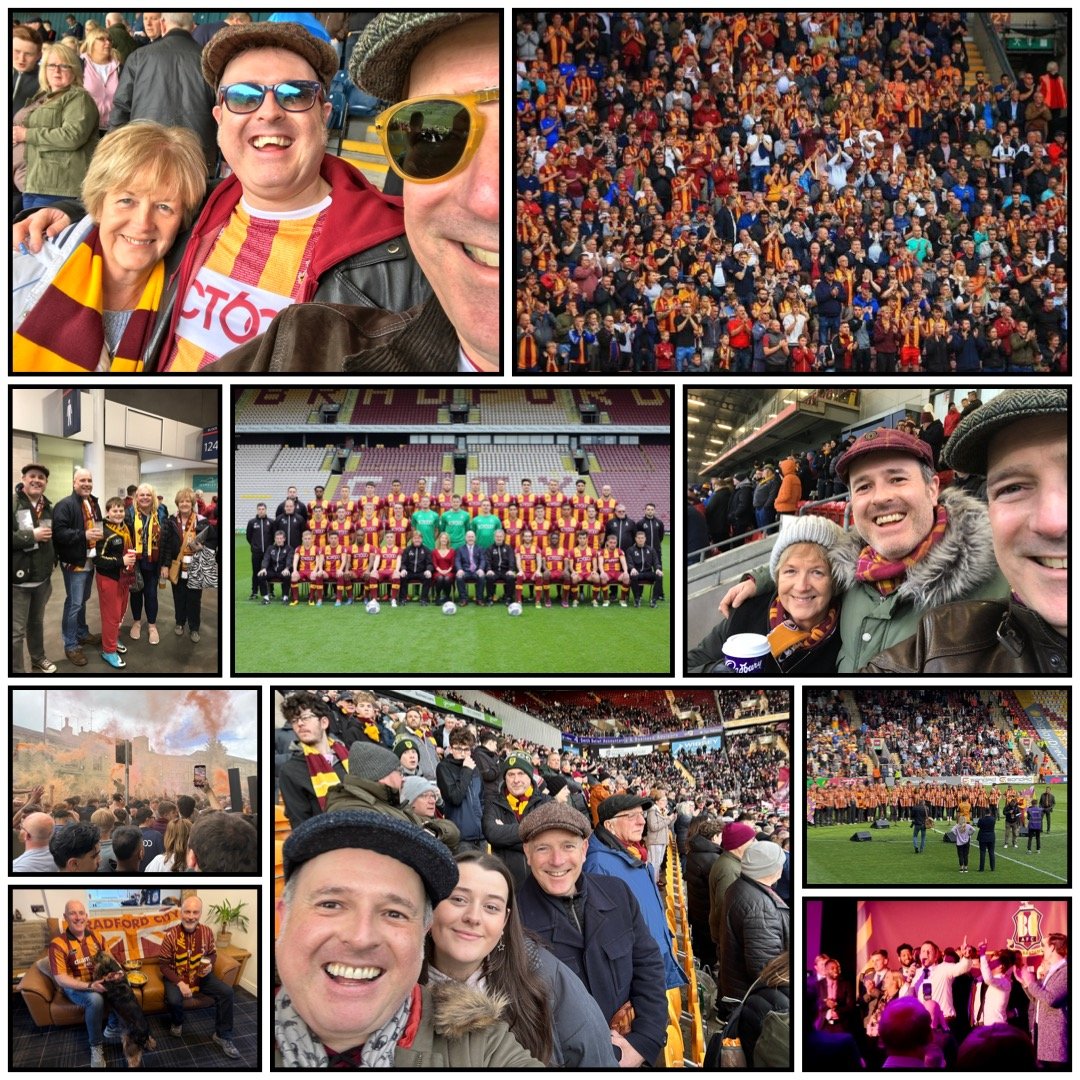
Various images over the years
