
ROOM 101: Villa Park, and 25 Years of Hurt
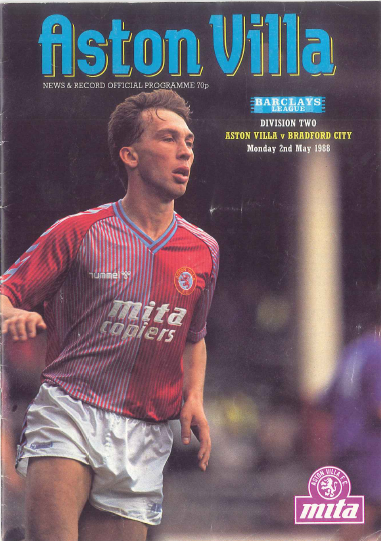
The Backstory Archive: I wrote this piece in January 2013, on the absolute precipice of history. Bradford City—then a bottom-tier League Two side—were a mere 90 minutes away from reaching the League Cup Final at Wembley, protecting a miraculous 3-1 first-leg lead against Premier League giants Aston Villa. As the city held its collective breath before the second leg at Villa Park, my mind didn't jump forward to Wembley. It drifted back exactly twenty-five years, to a freezing May Day in 1988 when Villa Park became the graveyard of my teenage football dreams. Looking back now from life’s Second Act, it’s a reminder of how sports anchor our personal timelines—capturing exactly who we were, who we travelled with, and how long we are willing to carry a grudge.
A version of this article first appeared on the award-winning football site The Width of a Post in January 2013.
The Football Room 101
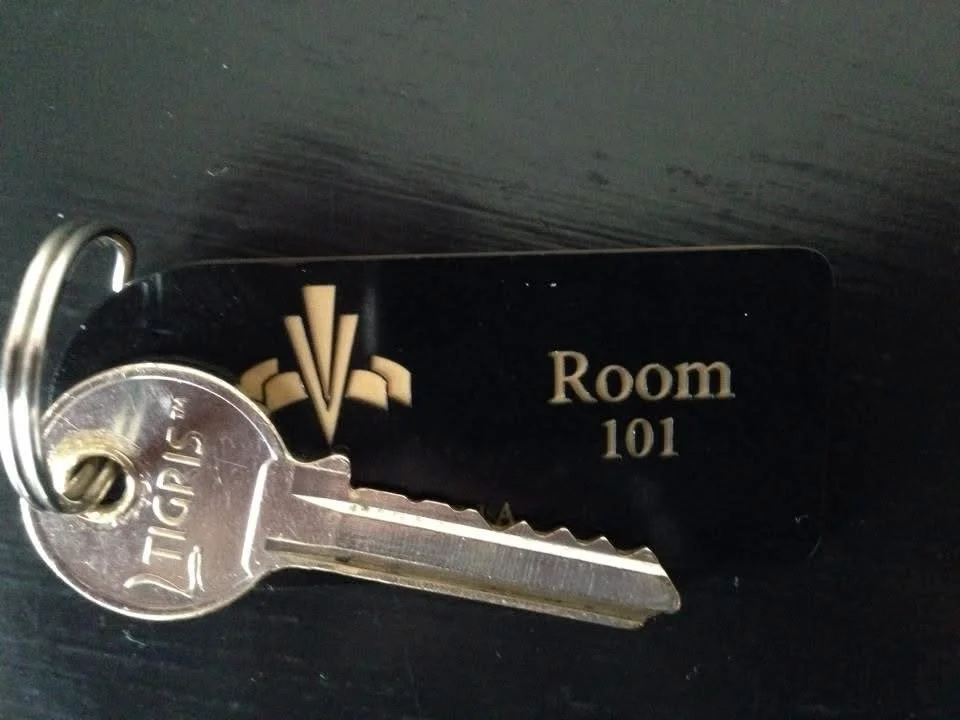
Every long-standing football fan maintains a private "do not disturb" filing cabinet in their mind. It’s a mental Room 101 where we carefully consign the most agonizing, heartbreaking results. We leave them there in the dark, hoping that some future, miraculous victory will finally arrive to grant us a sense of closure.
If you support Bradford City, you have a vast catalogue to choose from. There are the grim Tuesday nights at Accrington, a bizarre 6-4 home capitulation to Swansea, and crushing cup quarter-final exits to Bristol City and Luton Town.
But for me, the deepest scar belonged to Villa Park, May 1988.
The 1987/88 season coincided with my first year at the University of Birmingham. As City’s fantastic run in Division Two—the Championship in old money—gathered pace, I spent my student grant navigating the Midlands rail network, taking in every away game my budget could stretch to.
It is slightly distressing to realise that 1988 is now a lifetime away. Margaret Thatcher, Neil Kinnock, and Ronald Reagan dominated the news broadcasts. Arthur Scargill was still a household name, and the hated Poll Tax was being trialled north of the border, keeping the puppeteers at Spitting Image working overtime. On the radio, the soundtrack was a chaotic mix of the Pet Shop Boys, U2, Kylie Minogue, early House music, and that glorious, nonsensical number-one hit, "Doctorin’ the Tardis" by The Timelords.
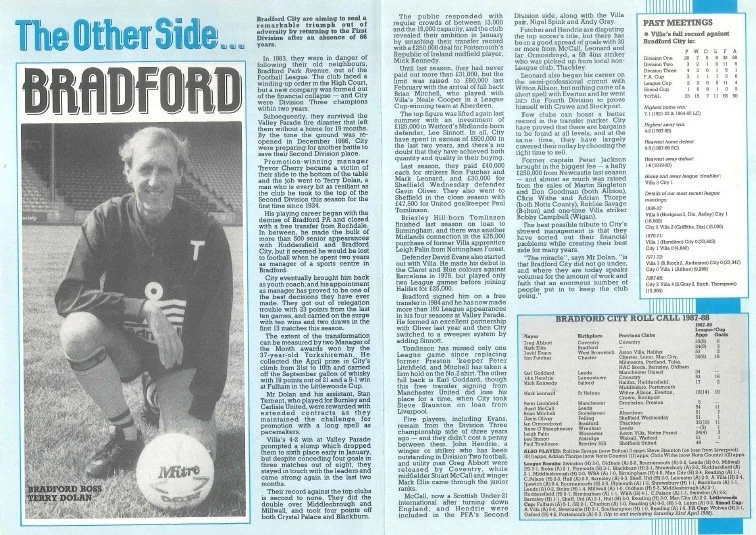
In the wider football world, cup shocks were the currency of the year. Luton Town and Wimbledon threw the formbook out the window to lift the League and FA Cups. Meanwhile, Bradford City had spent the entire winter flying high near the top of the table. After surviving a rocky patch in March, a thumping 4-1 win over Leicester City in April left us sitting pretty in second place with just two games left to play. Automatic promotion to the top flight of English football was within our grasp.
The date with destiny was set for May Day: a trip to Birmingham to face Aston Villa.
Into the Lion's Den
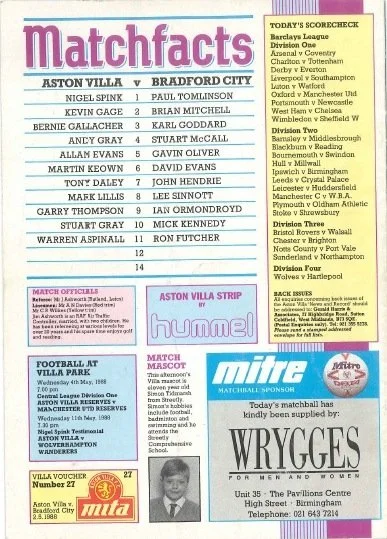
Villa had been relegated the previous season and were desperate to bounce straight back. Managed by Graham Taylor, they played a trademark, uncompromising brand of direct, route-one football. Their squad was formidable, built around the physical presence of Warren Aspinall, Alan McInally, and a 22-year-old midfield dynamo named David Platt, whom they had snapped up from Crewe for a cool £200,000.
City’s squad, by contrast, was tiny but fiercely consistent. Terry Dolan’s starting eleven rolled off the tongue: Tomlinson, Mitchell, Goddard, McCall, Oliver, Evans, Hendrie, Sinnott, Ormondroyd, Kennedy, Futcher. In those days, managers were only allowed to name two substitutes on the bench. It was a completely different universe from today's heavily rotated squads.
I remember boarding the train from Birmingham New Street to Aston. The carriage was an absolute pressure cooker, crammed to the windows with vocal Villa fans. I was accompanied by a few university mates who, despite having no allegiance to Bradford, had tagged along to offer some moral support at a critical moment. We kept our heads down, kept our mouths shut, and tried our best to blend into the background.
When we arrived at the ground, the atmosphere was electric. The historic old stadium was absolutely rocking, packed to the rafters with 36,423 fans. I was stunned by the sheer scale of the travelling support—well over 6,000 Bradfordians were squeezed into the lower tier of the away end, creating an unbelievable wall of claret and amber noise. Standing room only, packed shoulder-to-shoulder, waiting for the spark.
The Anatomy of a Collapse
The match itself remains a blur of adrenaline and anxiety. We started brightly enough. John Hendrie went close early on, stoking the belief that we could actually pull off the impossible.
Then came the sucker punch. The enduring, painful image of that afternoon is David Platt rising majestically in the air, connecting with a bullet header, and planting it past Paul Tomlinson right in front of the travelling away fans.
We fought back, and Ian Ormondroyd went agonizingly close to an equaliser, but the truth was undeniable: we were second best on the day. The final whistle triggered a massive pitch invasion by thousands of ecstatic Villa fans. We stood there on the terraces, watching the celebrations, trapped in the hollow quiet of what might have been.
The journey back to the university halls was a miserable, laboured crawl through train stations overflowing with singing locals. The sickening feeling that months of beautiful, hard work had evaporated in ninety minutes was impossible to shake.
Yet, the football gods weren't done torturing us. Despite the disaster at Villa, results elsewhere meant everything came down to the final match of the season: a home game against Ipswich Town at a packed Valley Parade. Ipswich had absolutely nothing to play for. Without the suspended talisman John Hendrie, City promptly self-destructed, losing 3-2. A win would have guaranteed automatic promotion; instead, Aston Villa took the coveted second-place spot by virtue of a 0-0 draw at Swindon. We were consigned to the lottery of the play-offs, where we promptly fell apart against Middlesbrough. The "Nearly Season" was born.
As a sobering, deeply uncalled-for footnote to that entire experience, a strange quirk of university fate decreed that out of all the hundreds of students I could have been randomly assigned to share a halls room with in my first year, my roommate was a die-hard Ipswich Town fan. You can only imagine the absolute, unadulterated agony of walking back into that bedroom after the final whistle.
The Class of 2013
For twenty-five years, that May Day defeat has sat undisturbed in my mental Room 101. I’ve returned to Villa Park since then to watch top-flight football, but the ghost of 1988 has always lingered near the corner flag.
Which brings us to tonight.
The class of 2013 has a chance to finally exorcise that ghost. Ninety minutes separate a group of League Two history-makers from Wembley Stadium. No pressure, boys. But please, sort it out. And keeping the university theme alive, I’ll happily take a 2:1 result either way.
Postscript: The Exorcism (Written in 2026)
They sorted it out.
On that freezing January night in 2013, the class of League Two history-makers didn't just hold the line against Premier League millionaires; they fought like lions. We lost the battle that night 2-1, but won the war 4-3 on aggregate. James Hanson’s towering second-half header became our generation's David Platt moment—only this time, the limbs, the tears, and the disbelief belonged to the away end.
We went to Wembley. The 25-year-old ghost of Room 101 was finally laid to rest on the Villa Park turf, buried under a mountain of claret and amber celebrations.
Looking back now from the calm of life’s Second Stage, I realise that football rarely offers perfect closure. Mostly, it’s just a cycle of cold Tuesdays, heavy legs, and deferred hope. But every now and then, the universe lets an unfashionable club from West Yorkshire rewrite the script.
The Ipswich fan from my university halls never got back in touch, but that’s fine. Some victories are best savoured in quiet, lifelong satisfaction.
